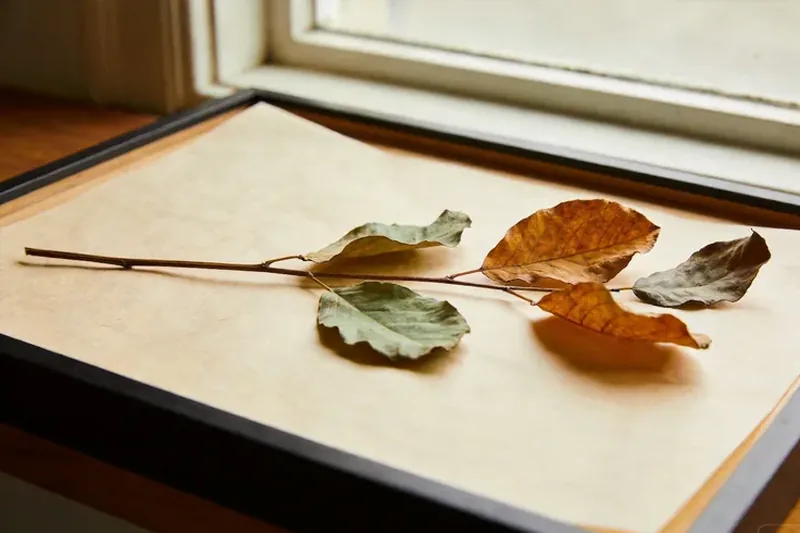
Direct answer: Arborvitae leaves (侧柏叶, cèbǎi yè) are the leafy branchlet of the oriental arborvitae, Platycladus orientalis (侧柏), a cypress-family tree native to China and Korea. It is the leafy part of the very same tree that yields cypress seed (柏子) — same species, different part. The Bencao Gangmu records 柏 in its tree section, explaining the name 侧柏 from the flat, sideways-growing leaves.
Key facts
| Chinese | 侧柏叶 (cèbǎi yè); tree = 侧柏 (cèbǎi) |
| Botanical source | Platycladus orientalis (family Cupressaceae) — the leafy branchlets |
| What it is | The leafy part of the arborvitae, distinct from its seed |
| Aroma | Woody, fresh, green, slightly resinous |
| Traditional role | 侧柏叶 in materia medica; the tree of 柏子香 |
Aroma profile
Direct answer: 侧柏叶 has a fresh, woody, green scent with a slightly resinous edge — the crisp, conifer note of crushed arborvitae foliage. It is lighter and greener than the roasted, nutty warmth of the tree’s seed (柏子), reading more like a fresh evergreen branch than a food.
侧柏叶 has a fresh, woody, green scent with a slightly resinous edge — the crisp, conifer note of crushed arborvitae foliage. It is lighter and greener than the roasted, nutty warmth of the tree’s seed (柏子), and it reads more like a fresh evergreen branch than a food. Its aromatic role is quiet; the classical fame of the tree belongs to its seed (the 柏子香 material), while the leaf is chiefly a materia-medica part.
Botanical identity
Direct answer: Platycladus orientalis, the oriental arborvitae, is a cypress-family evergreen native to China and Korea, widely planted for ornament, timber, and its aromatic parts. The species bears both a leafy branchlet (侧柏叶) and a seed (柏子/柏子仁), used for different purposes — the same botanical identity underlies both entries on this site.
Platycladus orientalis, the oriental arborvitae, is a cypress-family evergreen native to China and Korea, widely planted for ornament, timber, and its aromatic parts. The species bears both a leafy branchlet (侧柏叶) and a seed (柏子/柏子仁), used for different purposes. Flora of China records the species; the same botanical identity underlies both the leaf and seed entries here. See Platycladus orientalis in Flora of China.
Chinese name and terminology
Direct answer: The name 侧柏 means “sideways cypress” — 侧 (side/sideways) + 柏 (the cypress/arborvitae register). The Bencao Gangmu explains it from the leaf’s flat, side-oriented growth: only the flat, sideways-growing leaves are taken for use, hence 侧柏. The 柏 character, as with 崖柏 and 柏子, names a broad conifer class.
The name 侧柏 (cèbǎi) is a growth-form name: 侧 “side/sideways” + 柏, the cypress/arborvitae character. The Bencao Gangmu (本草纲目) explains it precisely from the leaf: “入药惟取叶扁而侧生者,故曰侧柏” — only the flat, sideways-growing leaves are taken for use, hence 侧柏. As with 崖柏 and 柏子, the 柏 character is a category marker — “cypress/arborvitae conifer” — not a species name, which is why these three 柏-named materials are easily blurred despite naming different species and parts.
One tree, two incense entries (read this)
Direct answer: 侧柏叶 and 柏子 come from the same tree, Platycladus orientalis, but are different parts with different roles: the leaf is chiefly a materia-medica part, while the seed is the classical incense material (柏子香). The two entries on this site are a worked example of the same botanical identity split across different materials — a knowledge-graph distinction, not a botanical one.
侧柏叶 and 柏子 come from the same tree, different parts:
- 侧柏叶 (arborvitae leaves) — the flat, sideways-growing leafy branchlets of Platycladus orientalis. This entry.
- 柏子 (cypress seed) — the seed of the same tree, the material of the classical 柏子香 incense. Its own entry.
The Bencao Gangmu (本草纲目), tree section (木之一), records the tree under 柏, explaining “入药惟取叶扁而侧生者,故曰侧柏” — only the flat, side-growing leaves are taken, hence 侧柏 — while the seed (柏实/柏子仁) is treated as its own materia-medica part. This is a clean illustration of how one plant can produce two distinct encyclopedia entries: same botanical identity, different parts, different uses, different entries. The leaf is a fresh, green materia-medica part; the seed is a roasted, nutty incense material. This page describes 侧柏叶 = the leafy branchlets, not the seed. See cypress-seed.
The leaf-versus-seed boundary in practice
Direct answer: The practical meaning of “same tree, different parts” is a sourcing rule: the leaf and the seed are bought and used differently. The leaf is a fresh, green, materia-medica part; the seed is a roasted, nutty incense material. A buyer who conflates them buys the wrong part of the tree.
The leaf-versus-seed split is not a technicality; it is a sourcing rule:
- Different characters. The leaf is fresh, woody, green, and slightly resinous; the seed, once prepared (scalded, soaked in wine and honey, and dried), is roasted, nutty, and woody. They do not substitute for each other.
- Different uses. The seed is the material of the classical scholar’s incense 柏子香 — the deliberately inexpensive, everyman counterpoint to costly agarwood-and-musk blends. The leaf is chiefly a materia-medica part, not a classical incense lead.
- Different entries, one identity. This site keeps them as two entries precisely because a knowledge graph records parts as distinct materials even when the plant is one. The disambiguation is the content.
The lesson generalizes: when a single plant yields multiple aromatic parts, “the plant” is not specific enough for sourcing — the part is the material.
Where does arborvitae leaf come from?
Direct answer: Arborvitae leaf comes from the oriental arborvitae, Platycladus orientalis, a cypress-family tree native to China and Korea and widely planted for ornament and timber. The leafy branchlets — the flat, sideways-growing sprays — are the part of use.
Platycladus orientalis is native to China and Korea and widely planted for ornament, timber, and its aromatic parts. The leafy branchlets — the flat, fan-like sprays that give the tree its “sideways cypress” name — are the part used as 侧柏叶. The same tree supplies the seed (柏子) that carries the classical incense tradition.
Why is it used in incense?
Direct answer: 侧柏叶 is used as a fresh, green, conifer accent at most — a crisp evergreen note in blends and sachets. Its classical fame belongs to the seed (柏子香), not the leaf; the leaf’s role is chiefly materia medica, and its aromatic use is quiet and supporting.
侧柏叶’s role in incense is modest: a fresh, green, slightly resinous conifer note that can lend a crisp evergreen accent to a blend or sachet. It is not the tree’s classical incense material — that is the seed, the roasted, nutty 柏子 of 柏子香. The leaf’s primary role is materia medica, and its aromatic use is quiet and supporting, the fresh foliage counterpart to the seed’s roasted warmth.
How is it processed?
Direct answer: 侧柏叶 is used as the fresh or dried leafy branchlet, gathered and dried to preserve its green, conifer character. The leaf is a fresh-herb material, not a seed to be scalded and soaked — the seed’s classical preparation belongs to the other entry, not the leaf.
As a leafy material, 侧柏叶 is handled by drying: the flat, sideways-growing branchlets are gathered and dried to preserve their fresh, green, conifer character. This contrasts with the seed (柏子), whose classical preparation — scalding the green seeds, soaking them in wine and honey, and drying them — belongs to the seed entry, not the leaf. The leaf is a simple dried-herb material; its practical concern is freshness of the green note.
What determines arborvitae leaf quality?
Direct answer: Quality turns on part identity and freshness. The useful grade is the leafy branchlet of Platycladus orientalis — distinct from the seed (柏子) — gathered fresh and dried to retain its green, conifer note. A faded or musty batch has lost the freshness that is the material’s value.
The quality factors:
- Part identity — the leafy branchlet (侧柏叶), not the seed (柏子); same tree, different part and use.
- Freshness — a fresh, woody, green, slightly resinous note; the green volatiles fade with age.
- Condition — clean, well-dried branchlets, free of mold and excess woody stem.
- Species clarity — Platycladus orientalis, distinct from other 柏-named conifers such as 崖柏 (Thuja sutchuenensis).
Common forms
Direct answer: 侧柏叶 is sold as the dried leafy branchlet — whole sprays or cut. The whole-herb form serves the materia-medica and sachet use; a cut form serves blending as a fresh green accent.
| Form | Typical use |
|---|---|
| Dried whole branchlets | Materia medica; sachet |
| Cut / ground leaf | Blending as a fresh green accent |
In Chinese tradition
- Materia medica (Traditional Use): 侧柏叶 appears in traditional Chinese medicine. This is traditional materia-medica language, not modern clinical evidence.
- The tree of 柏子香 (Historical Record): the same Platycladus orientalis supplies the seed for the classical scholar’s incense 柏子香, recorded separately.
- Naming (Historical Record): the Bencao Gangmu (本草纲目) explains the name 侧柏 from the flat, sideways-growing leaves — “入药惟取叶扁而侧生者,故曰侧柏.”
Traditional use vs modern evidence
Direct answer: The materia-medica record is traditional, not established clinical fact, and this page makes no medical claims. The documented, non-medical facts are botanical identity, the Cupressaceae placement, and the leaf’s distinction from the seed.
- Traditional Use — 侧柏叶’s materia-medica role. Traditional language, not modern clinical evidence.
- Historical Record — the Bencao Gangmu (本草纲目) 木之一 record of 柏, with the naming explanation (“入药惟取叶扁而侧生者,故曰侧柏”) and the seed (柏实/柏子仁) treated as a separate part.
- Scientific Evidence — the botanical identity of Platycladus orientalis (Cupressaceae) is documented. We present no clinical or medical efficacy claims.
What buyers should look for
Direct answer: Buyers should confirm the part — 侧柏叶 is the leafy branchlet of Platycladus orientalis, distinct from the seed (柏子) — then judge freshness of the green, conifer note. The leaf is a materia-medica part; the seed is the classical incense material, so the part must be pinned down before buying.
For a buyer or formulator:
- Part — the leafy branchlet (侧柏叶), not the seed (柏子); same tree, different material and use.
- Freshness — a fresh, woody, green, slightly resinous note.
- Species — Platycladus orientalis, distinct from 崖柏 (Thuja sutchuenensis) and other 柏-named conifers.
- Role clarity — the leaf is chiefly a materia-medica part; the seed is the classical incense material.
Safety
Incense combustion produces smoke and particulate matter. Burn in a well-ventilated space, avoid inhaling concentrated smoke, and keep away from children and pets. This is editorial knowledge content, not medical advice.
Arborvitae leaves vs cypress seed
Direct answer: These are two parts of one tree, Platycladus orientalis, with different characters and uses. 侧柏叶 (the leaf) is fresh, green, and chiefly a materia-medica part; 柏子 (the seed) is roasted, nutty, and the classical 柏子香 incense material. Same species, different materials.
| Arborvitae leaves (侧柏叶) | Cypress seed (柏子) | |
|---|---|---|
| Botanical source | Platycladus orientalis — leafy branchlets | Platycladus orientalis — seed |
| Character | Fresh, woody, green, slightly resinous | Roasted, nutty, woody, resinous |
| Classical role | Materia medica | 柏子香 scholar’s incense |
| Preparation | Dried leaf | Scalded, wine-and-honey soaked, dried |
See cypress-seed (柏子), cedar, thuja, and the baizi incense recipe.
Our Industry View
Direct answer: 侧柏叶’s commercial lesson is that “the plant” is not a sufficient specification — the part is the material. A buyer who asks for “arborvitae” without naming leaf or seed has not specified anything, because the leaf (a fresh green materia-medica part) and the seed (a roasted incense material) are different purchases with different uses.
From a manufacturing perspective, 侧柏叶 is a textbook case of part-level specification:
- The part is the material. One tree, Platycladus orientalis, yields a leaf and a seed with different characters, preparations, and uses. “Arborvitae” alone is not a specification; the leaf and the seed are different purchases. A buyer who does not pin the part has not begun the purchase.
- The knowledge graph is the disambiguation. This site keeps the leaf and the seed as two entries not for botanical reasons but for sourcing reasons: a material record that distinguishes parts is what lets a buyer and an AI crawler alike resolve “arborvitae” into the right material.
- A modest supporting part, priced as one. The leaf is a fresh green conifer accent and a materia-medica part, not a precious material. Its commercial value is modest, and its role is supporting — the tree’s real incense fame sits with the seed.
In our view, 侧柏叶 is a fresh, green, supporting leaf whose real lesson is specification discipline: name the part, distinguish it from the seed, and price it as the modest materia-medica material it is.
Summary
侧柏叶 (arborvitae leaves) is the flat, sideways-growing leafy branchlet of Platycladus orientalis, the oriental arborvitae — the same tree that yields the classical incense seed 柏子, but a different part with a different role. The Bencao Gangmu (木之一) records the tree under 柏 and explains the name 侧柏 from the flat, side-oriented leaves, while the seed (柏子) is treated as its own materia-medica part. The leaf is a fresh, green, slightly resinous conifer part used chiefly in materia medica; the seed is the roasted, nutty material of 柏子香. The two entries are a worked example of part-level disambiguation — same botanical identity, different materials. Its medicinal uses are traditional language, not clinical evidence.
FAQ
What is 侧柏叶 (arborvitae leaves)? The flat, leafy branchlet of the oriental arborvitae, Platycladus orientalis (侧柏), a cypress-family tree native to China and Korea. It is the leafy part of the same tree that yields the cypress seed (柏子), but a distinct part with its own use, chiefly in materia medica.
Is 侧柏叶 the same as 柏子 (cypress seed)? No — same tree, different parts. 侧柏叶 is the leafy branchlet, fresh, woody, and green, used in materia medica; 柏子 is the seed, roasted and nutty, and is the material of the classical 柏子香 incense. The Bencao Gangmu (本草纲目) treats the leaf and the seed as separate materia-medica parts.
Why is it called 侧柏 (sideways cypress)? The Bencao Gangmu (本草纲目) explains: “入药惟取叶扁而侧生者,故曰侧柏” — only the flat, sideways-growing leaves are taken for use, hence the name 侧柏. The name describes the leaf’s flat, side-oriented growth, distinguishing the medicinal leaf from the tree’s other parts.
What does 侧柏叶 smell like? Fresh, woody, and green, with a slightly resinous edge — the crisp conifer note of crushed arborvitae foliage. It is lighter and greener than the roasted, nutty warmth of the tree’s seed (柏子), reading more like a fresh evergreen branch than a food.
Is arborvitae leaf a classical incense ingredient? Not as a lead material. The classical fame of Platycladus orientalis belongs to its seed (柏子), the material of 柏子香; the leaf (侧柏叶) is chiefly a materia-medica part. The tree links the two entries, but the incense material is the seed, not the leaf.
How should I buy arborvitae for incense? Specify the part first — the leaf (侧柏叶) for a fresh green accent or materia-medica use, or the seed (柏子) for the classical roasted incense material. Confirm the species (Platycladus orientalis, not 崖柏 or another 柏-named conifer), and check freshness of the green note for the leaf.
See also: cypress-seed (柏子), cedar, thuja, and the full scent guide.
Evidence & Sources
Botanical identity
Source: Platycladus orientalis in Flora of China · Platycladus orientalis on GBIF. Evidence type: Established.
Traditional Chinese use
Source: the Bencao Gangmu (本草纲目), 木之一, records 柏, explaining “入药惟取叶扁而侧生者,故曰侧柏”. Evidence type: Historically documented — materia medica; medicinal uses are traditional, not modern clinical evidence.
Authenticity / disambiguation
Source: 侧柏叶 (leafy branchlets) vs 柏子 (seed) — same tree, Platycladus orientalis, different parts. Evidence type: Practical screening.
Safety
Source: incense combustion produces smoke and particulate matter; burn in a well-ventilated space. Evidence type: Established.
Evidence status
| Layer | Status |
|---|---|
| Botanical identity | Established |
| Traditional use | Historically documented (materia medica) |
| Authenticity test | Practical screening |
| Health claims | Not established |
Sources
Sources: botanical references on Platycladus orientalis and the Bencao Gangmu (本草纲目) 木之一 record of 柏/侧柏叶. 侧柏叶 is documented as a materia-medica leaf, distinct from the seed 柏子; medicinal uses are treated as traditional, not established clinical fact. This is editorial knowledge content, not medical advice.