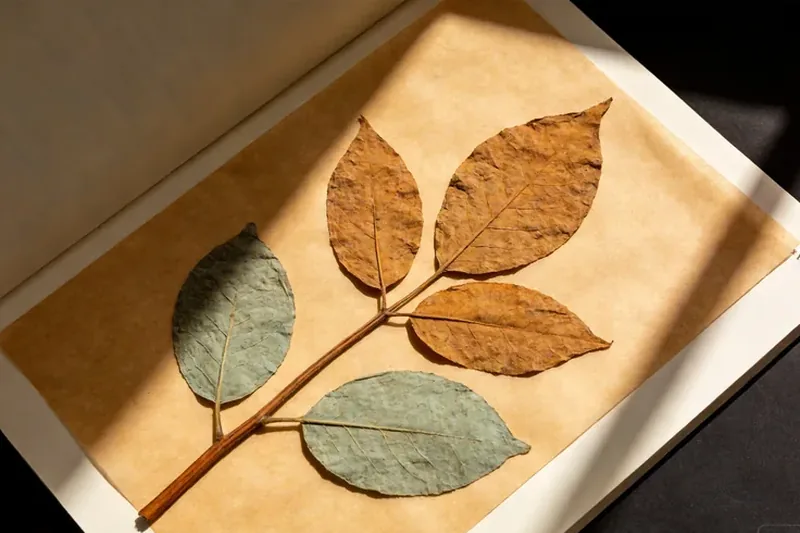
Direct answer: Mulberry leaf (桑叶, sāngyè) is the leaf of the white mulberry, Morus alba, a tree (Moraceae) cultivated across China for its silkworm-feeding leaves. It has a mild, green, tea-like, slightly sweet scent, and enters Chinese tradition chiefly as a fragrant tea and a materia-medica leaf — the “茶香” (tea-fragrance) context — rather than as a prominent incense material.
Key facts
| Chinese | 桑叶 (sāngyè); tree = 桑 (sāng) |
| Botanical source | Morus alba (family Moraceae) — the leaves |
| What it is | The leaf of the white mulberry, silkworm fodder and tea leaf |
| Aroma | Green, fresh, tea-like, slightly sweet |
| Traditional role | Tea and materia-medica leaf; not a lead incense material |
Aroma profile
Direct answer: 桑叶 has a mild, clean, green, tea-like scent with a faint sweetness — the gentle aroma of a brewed mulberry-leaf tea. It is a quiet, leafy-green note, closer to green tea than to any strong aromatic, and it works as a subtle green accent in sachets and tea-fragrance contexts rather than as a dominant incense note.
桑叶 has a mild, clean, green, tea-like scent with a faint sweetness — the gentle aroma of a brewed mulberry-leaf tea. It is a quiet, leafy-green note, closer to green tea than to any strong aromatic, and it works as a subtle green accent in sachets and tea-fragrance contexts rather than as a dominant incense note. The scent is a tea-fragrance character, not a wood, resin, or floral note — a mildness that places mulberry leaf in a distinct aromatic register.
Botanical source and origin
Direct answer: Morus alba, the white mulberry, is a shrub or small tree 3–10 m tall of the fig family (Moraceae), with ovate, irregularly lobed leaves 5–30 × 5–12 cm and a compound fruit (syncarp) that ripens from red to blackish-purple. It is originally endemic to central and northern China, now cultivated throughout China as silkworm fodder and for its fruit, bark fiber, and bark medicine.
Morus alba, the white mulberry, is a shrub or small tree of the fig family (Moraceae), native to China and cultivated for thousands of years as the food plant of the silkworm. Flora of China records it as a shrub or tree 3–10 m tall, with ovate to broadly ovate, irregularly lobed leaves 5–30 × 5–12 cm, and a compound fruit (syncarp) that is red when immature and blackish-purple, purple, or greenish-white when mature, 1–2.5 cm. It is recorded as originally endemic to central and northern China, now cultivated throughout China, and Flora of China adds that “the leaves provide food for silkworms, the bark fiber is used for textiles and paper, and the bark is also used for medicine.” The leaf (桑叶) and the fruit (桑葚) are distinct parts of the same tree. See Morus alba in Flora of China.
Chinese name and terminology
Direct answer: 桑叶 (sāngyè) means “mulberry leaf” — 桑 “mulberry” + 叶 “leaf” — and it names the leaf specifically, as distinct from the fruit 桑葚 and the root bark 桑白皮. The tree 桑 is one of the most culturally loaded plants in China, tied to sericulture, and the Bencao Gangmu records it under 桑 in its tree section.
The Chinese terminology separates the parts of one culturally central tree:
- 桑 (sāng) — the mulberry tree, the food plant of the silkworm, one of China’s most economically and culturally important trees.
- 桑叶 (sāngyè) — the leaf, the silkworm fodder and tea/materia-medica part.
- 桑葚 (sāngshèn) — the fruit.
- 桑白皮 (sāngbáipí) — the root bark, a separate materia-medica part.
The part-precision matters: 桑叶 is the leaf, not the fruit, and not the root bark — three different materials from one tree. The Bencao Gangmu (本草纲目) records the tree under 桑 in its tree section (木之三), with the leaf among its parts.
The tea-fragrance register (read this)
Direct answer: Mulberry leaf belongs to a distinct Chinese aromatic register — “茶香” (tea-fragrance) — the mild, green, leaf-like scent of brewed tea, distinct from woods, resins, and florals. This register is a real category in Chinese fragrance, and mulberry leaf sits in it alongside other quiet, leafy materials.
桑叶’s scent belongs to a register worth naming explicitly: 茶香 (tea-fragrance), the mild, green, leaf-like character of brewed tea. This is a distinct aromatic register in Chinese practice, separate from the woods, resins, and florals that dominate the 香材 canon:
- 茶香 (tea-fragrance) — the soft, green, slightly sweet note of brewed leaf; mulberry leaf, and materials like tea leaves and other leafy greens, sit here.
- Not a wood, resin, or floral — the register is deliberately quiet and leafy, used as a subtle accent rather than a dominant note.
Understanding mulberry leaf means understanding that its value is as a tea-fragrance accent — a mild, green, food-adjacent note — not as a strong aromatic. See bamboo leaves (竹叶) for another leafy material in a similar register.
In Chinese tradition
- Tea (Traditional Use): mulberry-leaf tea (桑叶茶) is a traditional fragrant, cooling drink, the “茶香” context in which the leaf’s mild green scent is most familiar.
- Materia medica (Traditional Use): 桑叶 appears in traditional Chinese materia medica, and the Bencao Gangmu (本草纲目) records the tree under 桑 (木之三), with 桑叶 among its parts. This is traditional materia-medica language, not modern clinical evidence.
- Incense (Traditional Use): mulberry leaf is not a lead 香材; its role is a quiet leafy-green accent.
Traditional use vs modern evidence
Direct answer: The tea and materia-medica records are traditional, not established clinical fact. The documented, non-medical facts are botanical identity, the Moraceae placement, the silkworm-feeding role, and the leaf’s tea-fragrance character.
- Traditional Use — 桑叶 in mulberry-leaf tea and in traditional materia medica (the Bencao Gangmu records the tree 桑). Traditional materia-medica language, not modern clinical evidence.
- Historical Record — the long cultivation of the mulberry as the food plant of the silkworm, and the Bencao Gangmu record of 桑 (木之三).
- Scientific Evidence — the botanical identity of Morus alba (Moraceae) is established. We present no clinical or medical efficacy claims.
The tea and materia-medica records are traditional, not established clinical fact, and we make no medical claims.
Why is mulberry leaf used in incense?
Direct answer: Mulberry leaf is not a lead incense material; where it appears, it lends a quiet, green, tea-like accent — a subtle leafy note in sachets and tea-fragrance blends. Its value is mildness and freshness, not intensity, and it is almost always a supporting element.
Mulberry leaf’s incense role is a quiet green accent. Its mild, tea-like note can lift a sachet or a light blend with a fresh, leafy character, but it does not carry the intensity of the woods and resins, and it is not a lead 香材. In practice it is used as a supporting element — a subtle green note in the tea-fragrance register — rather than burned as a dominant material. This is consistent with its primary life as a tea leaf and silkworm fodder: a quiet, useful leaf whose value is mildness, not power.
How is it processed?
Direct answer: Mulberry leaf is processed by harvesting and drying the leaf — the same basic step as tea — and it is used whole or cut, or ground for blending. There is no distillation or extraction in the leaf form; drying is the processing question, and freshness governs the mild green note.
The processing of 桑叶 is leaf-drying, essentially the same step as tea:
- Harvest — the leaves are harvested.
- Dry — the leaves are dried (traditionally, as for tea).
- Use whole / cut / ground — the dried leaf is used whole or cut for tea and sachets, or ground for blending.
There is no distillation or extraction step — mulberry leaf is a whole dried leaf. As with other leafy materials, drying temperature and freshness govern how much of the mild, green note survives.
What determines quality?
Direct answer: Quality turns on a clean, green, fresh leaf with a mild, tea-like scent and no mustiness. There is no standardized grading ladder; freshness, cleanliness, and the green tea-like character are the practical signals.
The quality factors:
- Freshness — the mild green note fades with age.
- Cleanliness — clean, sound leaf material without mustiness or foreign matter.
- Colour and character — a clean green leaf with a tea-like, slightly sweet scent.
There is no standardized commercial grading ladder for 桑叶; freshness and the green tea-like character are the practical signals.
Common forms
Direct answer: Mulberry leaf is sold as the whole or cut dried leaf and, for blending, as a ground powder. It is a loose dried-leaf material, not an oil or extract, and it is used as a quiet green accent rather than a lead material.
| Form | Typical use |
|---|---|
| Whole / cut dried leaf | Tea, sachets, traditional use |
| Ground leaf powder | Blended into sachets and light incense powders |
The distinction is functional — the same leaf in different physical forms. As a quiet, leafy material, it behaves like other tea-fragrance leaves: light, mild, and quick to release (and lose) its note.
What buyers should look for
Direct answer: Buyers should distinguish the leaf (桑叶) from the fruit (桑葚) and the root bark — different parts of the same tree — and expect a clean, green, tea-like, slightly sweet leaf. It is a quiet green accent, best understood in the tea-fragrance context, not a lead incense material.
For a tea, sachet, or sourcing buyer:
- Part — confirm 桑叶 is the leaf, not the fruit (桑葚) or the root bark (桑白皮).
- Role — understand it is a tea and materia-medica leaf, a quiet green accent rather than a lead 香材.
- Condition — clean, green, fresh leaf with a mild tea-like scent and no mustiness.
- Form — whole/cut leaf or ground powder, depending on the use.
Safety
Incense combustion produces smoke and particulate matter. Burn in a well-ventilated space, avoid inhaling concentrated smoke, and keep away from children and pets. This is editorial knowledge content, not medical advice.
Mulberry leaf vs other leafy materials
Direct answer: Mulberry leaf (桑叶), bamboo leaves (竹叶), and arborvitae leaves (侧柏叶) are all leafy materials, but they differ by plant and role: mulberry leaf is a tea-fragrance, silkworm-fodder leaf; bamboo leaves are a green, fresh leaf; arborvitae leaves are a materia-medica leaf from a conifer. Leafy materials share a green register but are distinct species with distinct roles.
| Leaf | Botanical source | Character / role |
|---|---|---|
| Mulberry leaf (桑叶) | Morus alba (Moraceae) | Green, tea-like; tea and materia-medica leaf |
| Bamboo leaves (竹叶) | Bambusoideae grasses | Green, fresh; a leafy accent |
| Arborvitae leaves (侧柏叶) | Platycladus orientalis (Cupressaceae) | Green, woody; a materia-medica leaf |
All three are leafy and green, but they are different plants with different roles. See bamboo leaves (竹叶), arborvitae leaves (侧柏叶), and sophora flower (槐花).
Our Industry View
Direct answer: Mulberry leaf’s lesson is the tea-fragrance register: a whole class of quiet, leafy, food-adjacent materials whose value is mildness, not intensity — and which are easy to overlook or over-rate. The disciplined buyer understands the register, names the part (leaf vs fruit vs root bark), and treats a mild leaf as an accent, not a base.
From a manufacturing and sourcing perspective, mulberry leaf is a reminder that not every aromatic material is bought for intensity:
- The tea-fragrance register is real and quiet. Mulberry leaf’s value is a mild, green, tea-like note — a register (茶香) distinct from woods, resins, and florals. It is easy to overlook because it is quiet, but it is also easy to over-rate if a buyer expects it to carry a blend. It is an accent, not a base.
- One tree, many parts, one specification. 桑叶 (leaf), 桑葚 (fruit), and 桑白皮 (root bark) are three different materials from one culturally central tree. A buyer who orders “mulberry” without naming the part is ordering a tree, not a material — the part-level name is the specification.
- Mildness is a feature, not a flaw. For sachets and light tea-fragrance blends, a mild, clean green note is exactly what is wanted. The right dose and blend context depend on formulation, not on a fixed figure.
In our view, the useful takeaway is procedural: understand the tea-fragrance register, name the part, and value mildness for what it is — and a quiet leaf like 桑叶 becomes a correctly specified accent instead of a vague “green note.”
Summary
Mulberry leaf (桑叶) is the leaf of the white mulberry, Morus alba, a Moraceae shrub or small tree originally endemic to central and northern China and now cultivated throughout China as the food plant of the silkworm. Its mild, green, tea-like scent belongs to the 茶香 (tea-fragrance) register, and it enters Chinese tradition as a fragrant tea and a materia-medica leaf rather than a lead incense material. It is one of several parts of the mulberry tree — leaf, fruit (桑葚), and root bark — that must be distinguished, and its value is a quiet green accent, not intensity. Medicinal uses are traditional language, not clinical evidence.
FAQ
What is 桑叶 (mulberry leaf)? The leaf of the white mulberry, Morus alba (Moraceae), a tree cultivated across China for its silkworm-feeding leaves. It has a mild, green, tea-like, slightly sweet scent and is used chiefly as a fragrant tea and a materia-medica leaf.
What tree does 桑叶 come from? The white mulberry (桑, Morus alba), the food plant of the silkworm, native to China. The Bencao Gangmu (本草纲目) records the tree under 桑 in its tree section (木之三), with the leaf (桑叶) among its parts alongside the fruit (桑葚) and root bark.
What does 桑叶 smell like? Mild, clean, green, and tea-like, with a faint sweetness — the gentle aroma of brewed mulberry-leaf tea. It is a quiet, leafy-green note, closer to green tea than to a strong aromatic, best used as a subtle accent.
Is mulberry leaf an incense ingredient? Not a lead one. Its traditional role is in tea (桑叶茶) and materia medica, in the “tea-fragrance” context, and it can lend a quiet green accent to a sachet or blend, but it does not carry the intensity of the resins and woods.
Is 桑叶 the same as 桑葚 (mulberry fruit)? No — different parts of the same tree. 桑叶 is the leaf; 桑葚 is the fruit. The Bencao Gangmu (本草纲目) records both under the tree 桑, but they are distinct parts with distinct uses, alongside the root bark (桑白皮).
Why is the mulberry culturally important in China? Because it is the food plant of the silkworm, the foundation of China’s sericulture industry for thousands of years. Flora of China records that the leaves feed silkworms, the bark fiber is used for textiles and paper, and the bark is also used for medicine — making the mulberry one of the most economically central trees in Chinese history.
See also: bamboo-leaves (竹叶), platycladus-leaves (侧柏叶), sophora-flower (槐花), and the full scent guide.
Evidence & Sources
Botanical identity
Source: Morus alba in Flora of China · Morus alba on GBIF. Evidence type: Established.
Traditional Chinese use
Source: the Bencao Gangmu (本草纲目), 木之三, records 桑, with 桑叶 among its parts. Evidence type: Historically documented — tea and materia-medica use; medicinal uses are traditional, not modern clinical evidence.
Authenticity / disambiguation
Source: 桑叶 (leaf) vs 桑葚 (fruit) — different parts of Morus alba. Evidence type: Practical screening.
Safety
Source: incense combustion produces smoke and particulate matter; burn in a well-ventilated space. Evidence type: Established.
Evidence status
| Layer | Status |
|---|---|
| Botanical identity | Established |
| Traditional use | Historically documented (tea / materia medica) |
| Authenticity test | Practical screening |
| Health claims | Not established |
Sources
Sources: botanical references on Morus alba and the Bencao Gangmu (本草纲目) 木之三 record of 桑/桑叶. 桑叶 is documented as the mulberry leaf; medicinal uses are treated as traditional, not established clinical fact. This is editorial knowledge content, not medical advice.