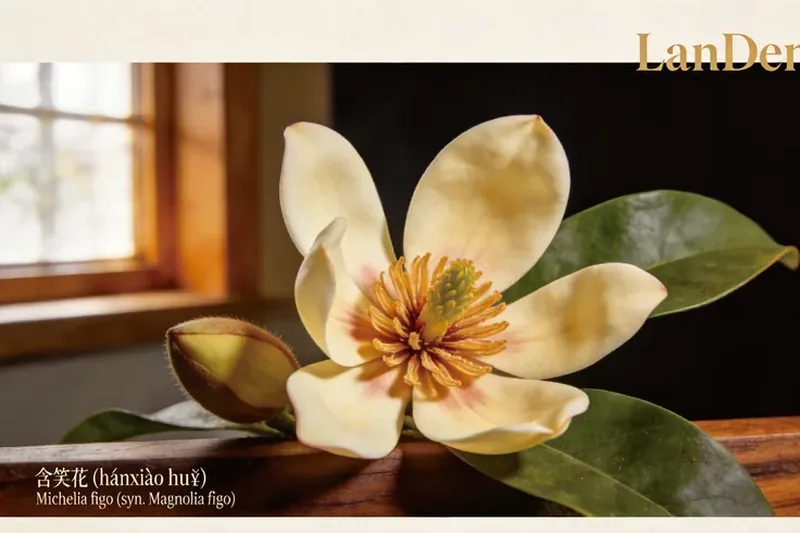
Direct answer: Michelia figo (含笑花, hánxiào huā) is the flower of Michelia figo (now often placed as Magnolia figo), a magnolia-family (Magnoliaceae) shrub native to southern China, prized for a sweet, fruity, banana-like fragrance. Its Chinese name means “the smiling flower,” from the way the blossoms open partway like a half-smile. It is closely related to, but distinct from, the white champaca (白兰花).
Key facts
| Chinese | 含笑花 (hánxiào huā) — “the smiling flower” |
| Botanical source | Michelia figo (syn. Magnolia figo, family Magnoliaceae) — the flower |
| What it is | A fragrant magnolia-family flower, not a wood or resin |
| Aroma | Sweet, fruity, floral, faintly banana |
| Traditional role | Garden and cut flower; southern aromatic blossom |
Aroma profile
Direct answer: 含笑花 is sweet and fruity-floral with a distinctive banana-like undertone — a warm, confectionary scent quite unlike the heady white-floral of champaca. It is a smaller, more delicate flower, and its fragrance reads as sweet and fruity rather than rich and enveloping, valued in the garden and as a cut flower rather than as a burned material.
含笑花 is sweet and fruity-floral with a distinctive banana-like undertone — a warm, confectionary scent quite unlike the heady white-floral of champaca. It is a smaller, more delicate flower, and its fragrance reads as sweet and fruity rather than rich and enveloping. In Chinese fragrance culture it is one of the aromatic blossoms of the south, valued for the garden and as a cut flower rather than as a burned incense material. The banana note is the diagnostic: it is what separates 含笑花 at once from the magnolia-floral champaca and from the cleaner white yulan.
The 含笑花 / 白兰花 distinction (read this)
Direct answer: 含笑花 and 白兰花 are closely related magnolia-family flowers that share the 兰 character and are sometimes confused. 含笑花 is Michelia figo — a small shrub with cream-yellow, banana-scented flowers — while 白兰花 is Michelia alba (champaca), a tree with larger, heady white flowers. 玉兰 (Magnolia denudata) is a third white magnolia.
含笑花 and 白兰花 are closely related magnolia-family flowers that share the 兰 character and are sometimes confused:
- 含笑花 (banana shrub) — Michelia figo (syn. Magnolia figo), a small shrub with cream-yellow, banana-scented flowers. This entry.
- 白兰花 (white champaca) — Michelia alba (syn. Magnolia × alba), a tree with larger, heady white flowers. Its own entry.
- 玉兰 (yulan magnolia) — Magnolia denudata, another white magnolia. Its own entry.
This page describes 含笑花 = Michelia figo = banana shrub. When a source says 白兰花 or 玉兰, it is describing a different magnolia-family flower. The 兰 character is a fragrance honorific shared across these unrelated-to-orchid flowers, not a claim of orchid identity.
Botanical source and origin
Direct answer: Michelia figo is a small evergreen shrub of the magnolia family (Magnoliaceae), native to southern China and cultivated for its fragrant, cream-yellow flowers. Taxonomy has moved the species between Michelia and Magnolia; the currently accepted name is Magnolia figo, with Michelia figo widely used as a synonym. The flower is small, often edged with purple, and opens only partway.
Michelia figo is a small evergreen shrub of the magnolia family (Magnoliaceae), native to southern China and cultivated for its fragrant, cream-yellow flowers. Taxonomy has moved the species between Michelia and Magnolia; the currently accepted name is Magnolia figo, with Michelia figo widely used as a synonym. The flower is small, often edged with purple, and opens only partway — hence the name “smiling flower.” This partway opening is the botanical root of the name: the blossom never fully unfurls, looking always half-smiling.
Where does 含笑花 come from?
Direct answer: 含笑花 is native to southern China, where it grows and is cultivated as a fragrant garden shrub. It is a regional southern aromatic — part of the same magnolia-family group as the champaca and yulan — rather than a scarce wild harvest or a modern imported flower.
Michelia figo is a southern Chinese native, grown and cherished as a garden shrub across the subtropical south for its sweet, fruity flowers. It belongs to the same broad magnolia-family group as the white champaca and the yulan magnolia, all of which are southern Chinese fragrant blossoms. As a common garden shrub, its supply is unremarkable, and its value lies in its distinctive banana-sweet fragrance rather than in any scarcity.
In Chinese tradition
Direct answer: 含笑花 is grown and displayed for its sweet, fruity, banana-like scent as a southern garden favorite, and the Ming-dynasty Xiangcheng (香乘) lists it among the fragrant blossoms, recording 韩熙载’s observation that “含笑 is suited to musk” (含笑宜麝) — a flower-to-incense pairing rather than a burned material.
- Garden and cut flower: 含笑花 is grown and displayed for its sweet, fruity, banana-like scent, a southern garden favorite.
- Named in 香乘: the Ming-dynasty Xiangcheng (香乘) lists 含笑 among the fragrant blossoms and records 韩熙载’s observation that “含笑 is suited to musk” (含笑宜麝) — a flower-to-incense pairing.
- Southern blossom: 含笑 is one of the aromatic flowers of the south (八芳草 includes 含笑), referenced in garden and fragrance culture rather than burned as a material.
Traditional use vs modern evidence
Direct answer: The garden, cut-flower, and fragrance-reference use is documented in the classical record, and the botanical identity is established. The 含笑宜麝 pairing is a classical flower-to-incense reference, not a burned material, and this page makes no medical claims.
- Traditional Use — 含笑花 as a garden and cut flower for its sweet, fruity scent, and the classical 含笑宜麝 flower-to-incense pairing. This is aromatic and cultural use, not medical.
- Historical Record — the Ming-dynasty Xiangcheng (香乘) lists 含笑 among the fragrant southern blossoms (八芳草) and records the 含笑宜麝 pairing; this is a documented classical record.
- Scientific Evidence — botanical identity (Magnoliaceae, Michelia figo syn. Magnolia figo) is established; no medical or clinical claims are made.
How is it used in fragrance?
Direct answer: 含笑花 is a living-plant and cut-flower fragrance rather than a burned incense material. Its sweet, fruity, banana-like scent is enjoyed on the shrub or as a cut flower, and it appears in the classical record as a flower-to-incense pairing (含笑宜麝), not as a 香材 burned in its own right.
含笑花’s role is fragrance-in-the-garden, not fragrance-in-the-burner. Its sweet, fruity scent is experienced on the living shrub or as a cut flower, and its classical appearances are as a reference — the Xiangcheng pairing it with musk (含笑宜麝) as a flower suited to accompany certain incenses — rather than as a material burned on its own. The practical point for a formulator is that 含笑花 is a delicate, heat-fragile floral: its banana-sweet charm belongs to the garden and the cut-flower vase, not to the combustion of a stick or cone.
What buyers should look for
Direct answer: A buyer should distinguish 含笑花 (Michelia figo, the banana-scented shrub flower) from 白兰花 (Michelia alba, champaca) and 玉兰 (Magnolia denudata) — different magnolia-family flowers. Expect a sweet, fruity, faintly banana scent, smaller and more delicate than champaca’s heady white-floral, and treat it as a garden/cut-flower material rather than a burned 香材.
For a sourcing buyer, the checks are:
- Species — confirm Michelia figo (syn. Magnolia figo), the banana shrub; distinguish it from 白兰花 (Michelia alba, champaca) and 玉兰 (Magnolia denudata), which are different magnolia-family flowers.
- Aroma — the tell is a sweet, fruity, banana-like character, smaller and more delicate than champaca’s heady white-floral.
- Role — it is a garden and cut-flower fragrance and a classical flower-to-incense reference (含笑宜麝), not a burned incense material.
- Name — the species may be listed under Michelia or Magnolia; both names refer to the same plant.
Our Industry View
Direct answer: 含笑花’s lesson is about the 兰-character trap: several unrelated-to-orchid flowers share the 兰 honorific in Chinese fragrance — 含笑花, 白兰花, 玉兰, and others — so the character is a fragrance honorific, not a botanical or classical-incense claim. The disciplined buyer reads past the shared character to the species, and treats delicate heat-fragile florals as garden or pairing references, not burned materials.
含笑花 is where the 兰-character naming trap is most instructive, and it carries two real lessons:
- The 兰 character is an honorific, not a taxonomy. 含笑花, 白兰花, and 玉兰 all carry 兰, yet none is an orchid — they are magnolia-family flowers, and 兰 here means “fragrant, refined” rather than “Orchidaceae.” A buyer who reads the character as a botanical claim is reading it wrong; the species is the only reliable identifier.
- Delicate florals are reference materials, not burner materials. Like tuberose, 含笑花’s sweet, fruity scent is heat-fragile. Its classical role is the garden, the cut-flower vase, and the flower-to-incense pairing (含笑宜麝) — a curated reference in 合香 aesthetics — not a material to burn. Recognizing which florals are for the burner and which are for the reference is basic competence.
- Classical pairing records are a distinct kind of evidence. The 含笑宜麝 note is not a “use as a 香材” but a pairing judgment — a classical observation of which flower suits which incense. It is a small but genuine piece of the southern fragrance canon, and it should be cited for what it is, not inflated.
In our view, 含笑花 is best understood as a southern garden aromatic with a documented classical pairing, valuable for its banana-sweet scent and its place in the 香乘 record, but not — and never claimed to be — a burned incense material.
Summary
含笑花 (Michelia figo, syn. Magnolia figo) is the “banana shrub,” a magnolia-family shrub of southern China whose small, partway-opening, cream-yellow flowers carry a sweet, fruity, banana-like scent. It is a garden and cut-flower aromatic, recorded in the Ming Xiangcheng (香乘) among the fragrant southern blossoms and paired with musk (含笑宜麝) — a flower-to-incense reference, not a burned material. Its lesson is the 兰-character honorific: several magnolia-family flowers share the character without being orchids, so species, not the shared name, is the buyer’s identifier.
FAQ
What is 含笑花 (banana shrub)? The flower of Michelia figo (now often Magnolia figo), a magnolia-family (Magnoliaceae) shrub native to southern China, prized for a sweet, fruity, banana-like fragrance. Its Chinese name means “the smiling flower,” from the way the small blossoms open partway like a half-smile.
Is 含笑花 the same as 白兰花 (champaca)? No, though they are closely related. 含笑花 is Michelia figo — a small shrub with cream-yellow, banana-scented flowers — while 白兰花 is Michelia alba (champaca), a tree with larger, heady white flowers. Both are magnolia-family flowers, which is the source of the confusion, and each has its own entry here.
What does 含笑花 smell like? Sweet and fruity-floral with a distinctive banana-like undertone — a warm, confectionary scent quite unlike the heady white-floral of champaca. It is a smaller, more delicate flower, and its fragrance reads as sweet and fruity rather than rich and enveloping.
How is 含笑花 used in Chinese culture? As a garden and cut flower valued for its sweet, fruity scent, and as a classical flower-to-incense reference — the Ming-dynasty Xiangcheng (香乘) records that “含笑 is suited to musk” (含笑宜麝), pairing it with specific incenses rather than burning it as a material.
What is the botanical name for 含笑花? Michelia figo, now often treated as Magnolia figo in the magnolia family (Magnoliaceae). Taxonomy has moved the species between Michelia and Magnolia, so both names appear. The flower — small, cream-yellow, partway-open — is the part used for fragrance.
Why is it called the “smiling flower”? Because the blossoms open only partway and never fully unfurl, giving them the look of a half-smile — the botanical root of the name 含笑 (“holding a smile”). The small, cream-yellow, often purple-edged flowers are the fragrant part.
See also: champaca, yulan-magnolia, aglaia and the full scent guide.
Evidence & Sources
Botanical identity
Source: Michelia figo in Flora of China · Magnolia figo (syn. Michelia figo) on GBIF. Evidence type: Established.
Traditional Chinese use
Source: the Ming-dynasty Xiangcheng (香乘) lists 含笑 among the fragrant blossoms (八芳草) and records the “含笑宜麝” flower-to-incense pairing. Evidence type: Historically documented — aromatic and cultural use, not medical.
Authenticity / disambiguation
Source: 含笑花 (Michelia figo, banana shrub) vs 白兰花 (Michelia alba, champaca) vs 玉兰 (Magnolia denudata) — distinct magnolia-family flowers. Evidence type: Practical screening.
Safety
Source: incense combustion produces smoke and particulate matter; burn in a well-ventilated space. Evidence type: Established.
Evidence status
| Layer | Status |
|---|---|
| Botanical identity | Established |
| Traditional use | Historically documented |
| Authenticity test | Practical screening |
| Health claims | Not established |
Sources
Sources: botanical references on Michelia figo (syn. Magnolia figo) and the 含笑花/白兰花/玉兰 distinction. 含笑花’s garden and fragrance-reference use is documented; no medical claims are made. This is editorial knowledge content, not medical advice.