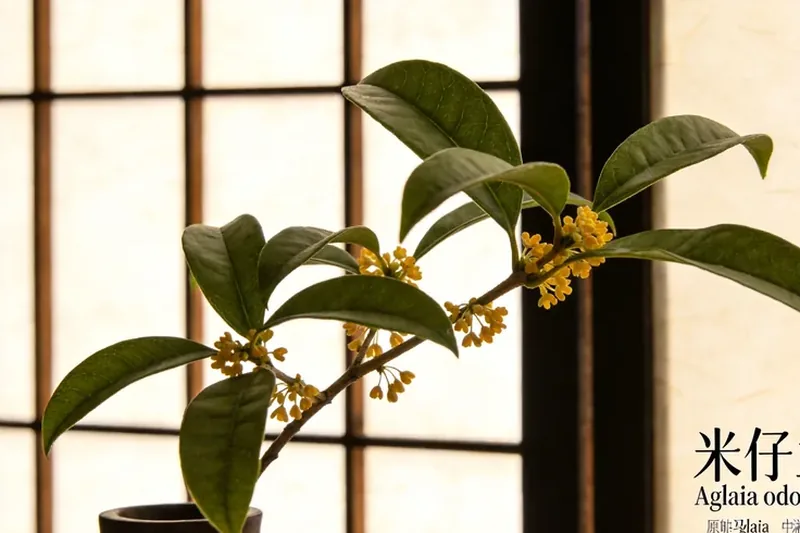
Direct answer: Aglaia (米仔兰, mǐzǎilán) is a small evergreen tree or shrub of the mahogany family (Meliaceae), Aglaia odorata, native to southern China and Southeast Asia. Its tiny, yellow, bead-like flowers are intensely and sweetly fragrant, grown across the subtropical south as a garden and courtyard fragrant plant. It does not appear in the Ming Xiangcheng (香乘).
Key facts
| Chinese | 米仔兰 (mǐzǎilán); also 米兰, 树兰, 珠兰 |
| Botanical source | Aglaia odorata (family Meliaceae) — the flowers |
| What it is | A fragrant flowering shrub, not a wood or resin |
| Aroma | Sweet, floral, fruity, delicate |
| Traditional role | Southern garden/courtyard fragrant flower |
Aroma profile
Direct answer: 米仔兰 is sweet and floral with a delicate, slightly fruity (often described as lemon- or tea-adjacent) character — a fine-grained, intimate fragrance carried on tiny clusters of bead-sized yellow flowers. It is softer and less heady than jasmine or champaca, closer to a subtle, sweet garden scent, enjoyed as a living plant rather than as a burned material.
米仔兰 is sweet and floral with a delicate, slightly fruity (often described as lemon- or tea-adjacent) character — a fine-grained, intimate fragrance carried on tiny clusters of bead-sized yellow flowers. It is softer and less heady than jasmine or champaca, closer to a subtle, sweet garden scent. In practice it is a living-plant fragrance, enjoyed in the garden or courtyard rather than as a burned material. The intimacy is the point: the flowers are tiny and the scent subtle, so it rewards proximity — a fragrance of the close garden, not of the room-filling burner.
A southern flower, honestly placed (read this)
Direct answer: 米仔兰 belongs to the garden, not to the classical incense compendium. Despite the word 兰 (“orchid”) in several of its common names — 米仔兰, 米兰, 树兰, 珠兰 — it is not an orchid but a mahogany-family tree (Aglaia odorata, Meliaceae), and it is absent from the Ming-dynasty Xiangcheng (香乘). No classical incense pedigree is claimed.
米仔兰 belongs to the garden, not to the classical incense compendium. Despite its southern popularity and the word 兰 (“orchid”) in several of its common names — 米仔兰, 米兰, 树兰, 珠兰 — it is not an orchid (Orchidaceae) but a mahogany-family tree (Aglaia odorata, Meliaceae), and it is absent from the Ming-dynasty Xiangcheng (香乘). The 兰 in its name is a fragrance honorific shared by many unrelated sweet-scented plants, not a botanical or a classical-incense claim.
This page describes 米仔兰 = Aglaia odorata. We state plainly that it is a southern garden fragrant flower with no recorded 香乘 incense role, rather than borrowing an antique pedigree it does not have.
Botanical source and origin
Direct answer: Aglaia odorata is a small evergreen tree or shrub of the mahogany family (Meliaceae), native to southern China and Southeast Asia and long cultivated as an ornamental and fragrant plant across the subtropical south. Its tiny, round, yellow flowers in loose clusters are the fragrant part; the names 米仔兰 and 米兰 describe the bead-sized flowers. Flora of China records the species.
Aglaia odorata is a small evergreen tree or shrub of the mahogany family (Meliaceae), native to southern China and Southeast Asia and long cultivated as an ornamental and fragrant plant across the subtropical south. Its flowers are tiny, round, and yellow, borne in loose clusters, and are the fragrant part; the name 米仔兰 (“rice-grain orchid”) and 米兰 (“rice orchid”) describe the bead-sized flowers. Flora of China records the species. The genus Aglaia belongs to the mahogany family — unrelated to the orchids, the magnolias, or any other 兰-bearing flower, which is exactly why the shared character is misleading.
Where does aglaia come from?
Direct answer: Aglaia odorata is native to southern China and Southeast Asia, where it has long been cultivated as an ornamental and fragrant garden plant across the subtropical south. It is a common cultivated shrub, not a scarce wild harvest, and its value lies in its delicate flower scent.
The plant ranges across southern China and Southeast Asia, long grown as an ornamental and fragrant shrub in the subtropical south. It is a common garden plant — planted in courtyards, gardens, and pots for its sweet, delicate flower scent — rather than a scarce wild material. Its commercial and cultural value rests entirely on the fragrance of its tiny yellow flowers, which are enjoyed on the living plant rather than harvested or burned.
In Chinese culture
Direct answer: 米仔兰 is planted for its sweet, delicate flower scent, enjoyed in gardens, courtyards, and pots across the south. Its common names carry 兰, a fragrance honorific shared by many unrelated sweet-scented plants — not a botanical orchid — and it has no entry in the Ming Xiangcheng (香乘).
- Courtyard and garden fragrance: 米仔兰 is planted for its sweet, delicate flower scent, enjoyed in gardens, courtyards, and as a potted fragrant plant in the south.
- The 兰 honorific: its common names (米仔兰, 米兰, 树兰) carry 兰, a fragrance honorific shared by many unrelated sweet-scented plants — not a botanical orchid.
- Not a 香乘 ingredient: 米仔兰 has no entry in the Ming-dynasty Xiangcheng (香乘), and its use is as a living fragrant plant, not a burned incense material.
Traditional use vs modern evidence
Direct answer: The garden and courtyard fragrance use is documented, and the botanical identity (Meliaceae) is established. 米仔兰 is not a classical 香乘 incense ingredient, and this page records that absence honestly; no medical claims are made.
- Traditional Use — 米仔兰 as a southern garden and courtyard fragrant plant, enjoyed on the living shrub for its sweet, delicate flower scent. This is aromatic and cultural use, not medical.
- Historical Record — the botanical record places Aglaia odorata in the mahogany family (Meliaceae), and its absence from the Ming Xiangcheng (香乘) is documented; no classical incense role is claimed.
- Scientific Evidence — botanical identity (Meliaceae, Aglaia odorata) is established, including the fact that it is not an orchid despite the 兰 honorific; no medical claims are made.
How is aglaia used?
Direct answer: 米仔兰 is used as a living fragrant plant — in gardens, courtyards, and pots — for the sweet, delicate scent of its tiny yellow flowers. It is a fragrance of presence, enjoyed on the plant, rather than a harvested, burned, or distilled incense material.
米仔兰’s use is presence, not extraction. The plant is grown to scent a courtyard or garden with its sweet, delicate, fine-grained fragrance, and it is enjoyed on the living shrub. Unlike jasmine or champaca, it is not a major extraction crop for perfumery, and unlike the classical 香材, it is not burned. This is a modest but real distinction: 米仔兰 is a garden fragrance, and its value is in the living plant’s intimate scent, which is why it has no classical incense record and none is claimed.
What buyers should look for
Direct answer: A buyer should recognize 米仔兰 as Aglaia odorata, a mahogany-family fragrant shrub — not an orchid, despite the 兰 in its names. Expect a sweet, floral, slightly fruity, delicate scent from the tiny yellow flowers, enjoyed as a living plant rather than a burned material, and treat any incense claim of 米仔兰 provenance with care.
For a sourcing buyer, the checks are:
- Species — confirm Aglaia odorata (Meliaceae); despite the 兰 in its names, it is a mahogany-family plant, not an orchid.
- Aroma — expect a sweet, floral, slightly fruity, delicate scent from tiny bead-sized yellow flowers, softer than jasmine or champaca.
- Role — it is a living garden fragrant plant, not a burned or distilled incense material; treat any claim of 米仔兰 as a classical 香材 with care.
- Name — its many names (米仔兰, 米兰, 树兰, 珠兰) all point to the same species; the shared 兰 is an honorific, not a botanical identity.
Our Industry View
Direct answer: 米仔兰’s lesson is about honesty in the absence of a pedigree. It is a genuinely fragrant southern flower that is neither an orchid nor a classical 香乘 ingredient, and this page states both facts plainly rather than inventing a classical lineage or a botanical claim. That disciplined honesty — recording an absence rather than filling it — is itself the editorial position worth preserving.
米仔兰 is the clearest case in this encyclopedia of a material whose value is honest ordinariness, and that carries a real lesson:
- Recording an absence is a form of accuracy. The plant has no 香乘 entry and is not an orchid, despite the 兰 in its names. Stating both plainly — rather than borrowing a classical pedigree or a botanical claim — is the correct editorial move, and it protects the credibility of every other page that does carry a documented classical record.
- The 兰 honorific is a recurring trap. 米仔兰 shares the 兰 character with orchids, champaca, yulan, and others, none of which are related. A buyer who reads 兰 as a botanical claim is systematically misreading Chinese fragrance naming; the species is always the reliable identifier.
- Garden fragrance is a legitimate category. Not every fragrant plant is a 香材. 米仔兰’s value — a delicate, intimate courtyard scent — is real and worth recording accurately, without inflating it into an incense material it is not.
In our view, 米仔兰 is a minor but instructive southern flower: its interest lies in what it honestly is not — not an orchid, not a classical 香材 — and in the discipline of recording that absence rather than manufacturing a pedigree.
Summary
米仔兰 (Aglaia odorata) is a mahogany-family (Meliaceae) shrub of southern China and Southeast Asia, grown as a garden and courtyard fragrant plant for the sweet, delicate, slightly fruity scent of its tiny bead-sized yellow flowers. Despite the 兰 (“orchid”) in its common names, it is not an orchid, and it is absent from the Ming Xiangcheng (香乘) — an absence this page records honestly rather than filling with a borrowed pedigree. Its value is as a living garden fragrance, and its lesson is the 兰-character honorific: in Chinese fragrance naming, the character marks sweetness, not Orchidaceae.
FAQ
What is 米仔兰 (aglaia)? A small evergreen tree or shrub of the mahogany family (Meliaceae), Aglaia odorata, native to southern China and Southeast Asia. Its tiny, yellow, bead-like flowers are sweetly and delicately fragrant, and it is grown as a garden and courtyard fragrant plant in the subtropical south.
Is 米仔兰 an orchid? No. Despite the 兰 (“orchid”) in its common names (米仔兰, 米兰, 树兰, 珠兰), Aglaia odorata belongs to the mahogany family (Meliaceae), not Orchidaceae. The 兰 is a fragrance honorific shared by many unrelated sweet-scented plants.
What does aglaia smell like? Sweet and floral, with a delicate, slightly fruity, tea- or lemon-adjacent character, carried on tiny clusters of bead-sized yellow flowers. It is softer and less heady than jasmine or champaca, closer to a subtle garden scent, and it is enjoyed as a living plant rather than a burned material.
Is 米仔兰 a classical Chinese incense ingredient? No. It does not appear in the Ming-dynasty Xiangcheng (香乘). Its use is as a southern garden and courtyard fragrant flower, not a burned incense material — an absence this entry records honestly rather than inventing a classical pedigree.
Where does aglaia grow? In southern China and Southeast Asia, where it is long cultivated as an ornamental and fragrant plant. Its tiny yellow flowers are the fragrant part, and the name 米仔兰 (“rice-grain orchid”) describes their bead-like size.
How is aglaia used? Primarily as a living fragrant plant — in gardens, courtyards, and pots — for the sweet, delicate scent of its flowers. It is a fragrance of presence, enjoyed on the plant, rather than a harvested or burned incense material.
See also: michelia-figo, champaca, orchid, and the full scent guide.
Evidence & Sources
Botanical identity
Source: Aglaia odorata in Flora of China · Aglaia odorata on GBIF. Evidence type: Established.
Traditional Chinese use
Source: 米仔兰 as a southern garden and courtyard fragrant flower; no entry in the Ming-dynasty Xiangcheng (香乘). Evidence type: Historically documented — garden fragrance; absence in the classical incense compendium recorded honestly.
Authenticity / disambiguation
Source: 米仔兰 (Aglaia odorata, Meliaceae) is not an orchid, despite the 兰 honorific in its names; vs michelia-figo (含笑花) and champaca (白兰花). Evidence type: Practical screening.
Safety
Source: incense combustion produces smoke and particulate matter; burn in a well-ventilated space. Evidence type: Established.
Evidence status
| Layer | Status |
|---|---|
| Botanical identity | Established |
| Traditional use | Historically documented (garden fragrance) |
| Authenticity test | Practical screening |
| Health claims | Not established |
Sources
Sources: botanical references on Aglaia odorata. 米仔兰 is a southern garden fragrant flower, not an orchid and not a 香乘 incense ingredient; no medical claims are made. This is editorial knowledge content, not medical advice.