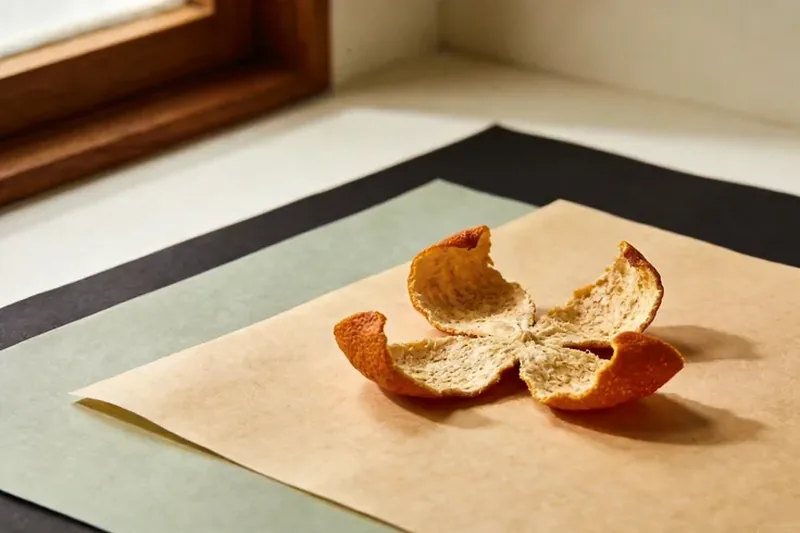
Direct answer: Litchi husk (荔枝壳, lìzhī ké) is the dried, leathery red husk (pericarp) of the litchi fruit, Litchi chinensis, a tropical evergreen tree of the soapberry family (Sapindaceae) native to southern China. It is a distinctly Chinese incense ingredient: the 香乘 records a “荔枝香” (litchi incense) made from the husk, praised as the freshest and most delicate of fruit-peel incenses. It is a fruit peel material.
Key facts
| Chinese | 荔枝壳 (lìzhī ké) |
| Botanical source | Litchi chinensis (family Sapindaceae) — the dried husk/pericarp |
| What it is | A dried fruit peel, not a wood or resin |
| Aroma | Sweet, fruity, faintly floral, mildly woody |
| Traditional role | Fruit-peel incense (荔枝香), a classical 香谱 specialty |
Aroma profile
Direct answer: Litchi husk, when dried and burned, gives a sweet, fruity, faintly floral scent that is notably fresh and delicate — lighter than citrus peel and less sharp than spice. It is a fruit-peel note in the same family as tangerine peel (陈皮), but sweeter and more floral, valued for its freshness rather than for a heavy or resinous scent.
Litchi husk, when dried and burned, gives a sweet, fruity, faintly floral scent that is notably fresh and delicate — lighter than citrus peel and less sharp than spice. It is a fruit-peel note, in the same family as tangerine peel (陈皮), but sweeter and more floral. The 香乘 singles it out: of the fruit peels, litchi husk makes the freshest, most refined incense (取其壳合香最清馥). The aroma is a top-note character — bright and lifting, not a deep base — which is exactly why classical practice blended it rather than burning it alone.
Botanical source and origin
Direct answer: Litchi chinensis is an evergreen tree of the soapberry family (Sapindaceae), often under 10 m and sometimes to 15 m or more, with pinnate leaves of 2–3 (or 4) pairs of leaflets and a red, globose fruit 2–3.5 cm. It is native to southwestern Guangdong and Hainan and has been cultivated in southern China — especially Fujian and Guangdong — for well over a millennium.
Litchi chinensis is a tropical evergreen tree of the soapberry family (Sapindaceae). Flora of China records it as an evergreen tree often under 10 m tall, sometimes to 15 m or more, with bark grayish black, leaves bearing 2 or 3 (or 4) pairs of leaflets 6–15 × 2–4 cm, and a dark-red, globose to subglobose fruit 2–3.5 cm that is thoroughly covered by a fleshy aril — the edible litchi — enclosed in the rough, leathery red husk (pericarp) that is the incense material. It flowers in spring and fruits in summer, and is recorded as native in southwestern Guangdong (Xuwen) and Hainan, widely cultivated in southern China, especially southern Fujian and Guangdong. The litchi has been cultivated in China for well over a millennium, and its husk — normally a discard — became a named incense material. See Litchi chinensis in Flora of China.
A naming caution: litchi husk (荔枝壳) is a fruit peel material, distinct from the litchi fruit itself and from other fruit peels such as tangerine peel (陈皮). It is valued for its sweetness and delicacy, not for the taste of the fruit.
Chinese name and terminology
Direct answer: The name 荔枝壳 is literal and part-precise: 荔枝 “litchi” + 壳 “husk/shell,” naming the pericarp specifically rather than the fruit or the tree. This part-precision is the key to the material — the incense is made from the discarded husk, not the flesh, and not a wood, resin, or flower.
The Chinese term is helpfully specific: 荔枝 (lìzhī) is the litchi, and 壳 (ké) is the husk or shell — so 荔枝壳 names the pericarp, the leathery outer covering, rather than the fruit flesh or the tree. This matters because the litchi is a fruit whose edible part (the fleshy aril) and its aromatic part (the husk) are completely different materials. A buyer who understands the part-level name knows they are being offered a peel, not a fruit product, and not a wood or resin.
The fruit-peel family (read this)
Direct answer: Litchi husk belongs to a small, distinctly Chinese family of fruit-peel incense materials alongside tangerine peel (陈皮) and pomelo peel (柚皮). They share a “fruit-peel” aromatic register — sweet, light, fresh — but are different species with different characters, and must not be conflated.
Litchi husk sits in a small family of Chinese fruit-peel materials, and the family itself is worth understanding:
- 荔枝壳 (litchi husk) — Litchi chinensis, the sweet, floral, most delicate of the peels; this entry.
- 陈皮 (tangerine peel) — Citrus reticulata, the aged mandarin peel with a warm, mellow, tea-like depth.
- 柚皮 (pomelo peel) — Citrus maxima, the bittersweet, floral-woody citrus peel with a thick white pith.
The three share a “fruit-peel” register — light, sweet, fresh, food-adjacent — but they are different plant families and different characters. Litchi husk is a soapberry-family pericarp, sweet and floral; 陈皮 and 柚皮 are rue-family (Rutaceae) citrus peels, one mellowed by age and the other by a bitter pith. They are not interchangeable, and each has its own entry: orange-peel (陈皮) and pomelo peel (柚皮).
In Chinese tradition
- 荔枝香 (litchi incense) (Historical Record): the 香乘 (Xiang Cheng) records 荔枝香 — an incense made from the litchi husk — quoting the 香谱: “取其壳合香最清馥” (“taking its husk to blend incense, it is the freshest and most refined”). It is a classical fruit-peel specialty.
- A distinctly Chinese material (Historical Record): litchi husk is a rare example of a fruit peel that became a named incense material in its own right, tied to the litchi’s southern-Chinese origin and its long cultivation.
- Materia medica (Traditional Use): 荔枝 is recorded in traditional Chinese medicine (本草綱目, 果部) with various described uses. This is traditional materia-medica language, not modern clinical evidence.
Traditional use vs modern evidence
Direct answer: The incense use is documented in the classical recipe record; the medicinal uses are traditional, not established clinical fact. The well-documented, non-medical facts are botanical identity and the husk’s role as a classical fruit-peel incense material — a burning aromatic, not a remedy.
- Traditional Use — 荔枝 in the 本草綱目 果部, with described medicinal uses. Traditional materia-medica language, not modern clinical evidence.
- Historical Record — the 香乘/香谱 record of 荔枝香 from the husk (“取其壳合香最清馥”), a documented classical incense recipe.
- Scientific Evidence — the botanical identity of Litchi chinensis (Sapindaceae) is established. We present no clinical or medical efficacy claims.
The incense use is documented in the classical recipe record. Medicinal uses are traditional, not established clinical fact, and we make no medical claims.
Why is litchi husk used in incense?
Direct answer: Litchi husk is used for its sweet, delicate, fruity-floral top note — a light, fresh character that lifts and brightens a blend without the sharpness of spice or the heaviness of resin. It is a blending accent, not a base, and is almost always mixed rather than burned alone.
Litchi husk’s incense role is a delicacy role. Its sweet, fruity, faintly floral note is light and fresh — the opposite of a heavy wood or resin — so it functions as a top-note accent that lifts a formula. Because the scent is delicate and volatile, it is nearly always blended; alone it reads thin, but in a 合香 formula it adds a refined, fruity brightness that the classical 香谱 rated as the freshest of the fruit peels. This is the same blending logic that governs other light, food-adjacent notes like 陈皮 and 柚皮: they brighten and round a blend rather than anchoring it.
How is it processed?
Direct answer: Litchi husk is processed simply — the husk is cleaned, dried, and used whole or ground. There is no distillation or extraction; it is a whole dried peel, and its delicacy means drying and storage conditions largely determine how much of the fresh, sweet note survives.
The processing is straightforward and entirely a drying-and-storage matter:
- Separation — the husk is separated from the fruit flesh.
- Cleaning and drying — the husk is cleaned and dried to a stable, storable form.
- Use whole or ground — the dried husk is used whole or ground for blending.
There is no distillation or extraction step — litchi husk is a whole dried peel. Because its sweet, fruity note is volatile, the practical variables are drying temperature and storage freshness: a well-dried, recently stored husk keeps its delicate lift, while an old or poorly dried batch reads flat. This is the same volatility that governs leafy herbs and light peels generally.
What determines quality?
Direct answer: Quality turns on freshness, cleanliness, and intactness — a clean, dry, intact husk with a faintly sweet, fruity scent when warmed. Because the note is delicate, freshness matters more than with heavier materials, and there is no standardized grading ladder.
The quality factors, in rough order:
- Freshness — the sweet, fruity note is volatile; a fresh husk is markedly more aromatic than a stale one.
- Cleanliness — freedom from fruit residue, mold, and foreign material.
- Intactness — clean, dry, intact husk pieces rather than crumbled or damaged material.
- Aroma on warming — a faintly sweet, fruity, floral lift; flatness signals age or poor drying.
There is no standardized commercial grading system for litchi husk; freshness, cleanliness, and the aroma on gentle warming are the practical signals.
Common forms
Direct answer: Litchi husk is sold as the dried whole husk and, less commonly, as a ground powder for blending. It is a loose dried-peel material, not an oil or extract, and it is used as a light accent rather than a lead material.
| Form | Typical use |
|---|---|
| Dried whole husk | Warming; 合香 blending |
| Ground husk powder | Blended into incense powders |
The distinction is functional, not a quality statement — the same husk in different physical forms. As a light, food-adjacent peel, it behaves like other leafy or peely materials: fine, low-density, and quick to release (and lose) its aroma.
What buyers should look for
Direct answer: Buyers should confirm the material is the husk (pericarp), not the fruit or another peel; then judge freshness and cleanliness — a dry, intact husk with a faintly sweet, fruity scent. Expect a light accent material, not a lead note, and specify drying and storage condition.
For an incense maker or sourcing buyer:
- Part — confirm 荔枝壳 is the husk (pericarp), not the fruit flesh and not a wood or resin.
- Species/identity — distinguish it from other fruit peels, chiefly 陈皮 (Citrus reticulata) and 柚皮 (Citrus maxima), which have different characters.
- Freshness and condition — clean, dry, intact husk with a faintly sweet, fruity scent; the note fades with age.
- Form — whole husk or ground powder, depending on the blending method.
Because it is a light, delicate material, a buyer is effectively specifying a top-note accent, and the freshness of the lot is the decisive quality variable.
Safety
Incense combustion produces smoke and particulate matter. Burn in a well-ventilated space, avoid inhaling concentrated smoke, and keep away from children and pets. This is editorial knowledge content, not medical advice.
Litchi husk vs other fruit peels
Direct answer: Litchi husk (荔枝壳), tangerine peel (陈皮), and pomelo peel (柚皮) are all fruit-peel materials but different species with different characters — sweet-floral for litchi, warm-mellow-aged for chenpi, bittersweet-floral for pomelo. They are not interchangeable.
| Material | Botanical source | Character |
|---|---|---|
| Litchi husk (荔枝壳) | Litchi chinensis (Sapindaceae) | Sweet, fruity, faintly floral, delicate |
| Tangerine peel (陈皮) | Citrus reticulata (Rutaceae), aged | Warm, mellow, tea-like, bittersweet-citrus |
| Pomelo peel (柚皮) | Citrus maxima (Rutaceae) | Bittersweet, floral-woody, thick pith |
Litchi husk is a soapberry-family pericarp, while 陈皮 and 柚皮 are rue-family citrus peels — so the “fruit-peel” label hides a real botanical split. See orange-peel (陈皮) and pomelo peel (柚皮).
Our Industry View
Direct answer: Litchi husk is the clearest example of a category modern sourcing under-serves: the fruit-peel incense. It is a byproduct — a discarded pericarp — turned into a named 香材, and its commercial value is entirely a matter of freshness and clean handling, not rarity or grading. That makes it a cheap, high-surface-area, batch-variable material that must be bought on condition, not on a name.
From a manufacturing perspective, litchi husk illustrates something that is easy to overlook in an encyclopedia of woods and resins: the fruit-peel category is a real, classical Chinese aromatic register, and it is a byproduct category.
Three points follow:
- It is a byproduct turned 香材. Litchi husk is the discarded pericarp of a fruit grown primarily for eating. Its value in incense is a recovery — a use found for material that would otherwise be waste. That is unusual in the classical canon, which is dominated by deliberately harvested woods, resins, and flowers, and it explains why the peel is light, cheap, and food-adjacent.
- Freshness is the whole specification. Unlike a resin or a dense wood, which can keep for years, a delicate fruit-peel note is volatile and fades. The difference between a good and a poor lot of litchi husk is almost entirely a matter of how recently and how well it was dried and stored — which makes condition, not a nominal grade, the buyer’s real check.
- Low density changes handling. A peel is high-surface-area and light, so particle behavior, packing, and burn differ from wood or resin powder. The right grind and dose depend on formulation, not on a fixed figure.
In our view, the commercial sweet spot is a clean, freshly dried, correctly identified litchi husk bought as a delicate top-note accent — a material whose value is honesty about its byproduct origin and its volatility, rather than any claim of rarity.
Summary
Litchi husk (荔枝壳) is the dried pericarp of the litchi fruit, Litchi chinensis, a Sapindaceae tree native to southwestern Guangdong and Hainan and long cultivated in southern China. It is a rare example of a fruit peel becoming a named classical incense material — the 香乘 records 荔枝香 (“取其壳合香最清馥”) as the freshest, most refined of the fruit peels. Its sweet, fruity, faintly floral note is a delicate top-note accent, almost always blended, and it sits in a small Chinese family of fruit-peel materials alongside 陈皮 (aged mandarin peel) and 柚皮 (pomelo peel), all different species. Commercially its value is freshness and clean handling, not rarity — a byproduct 香材 whose condition is the real specification.
FAQ
What is litchi husk incense? An incense made from the dried, leathery red husk (pericarp) of the litchi fruit, Litchi chinensis. The 香乘 (Xiang Cheng) records a “荔枝香” (litchi incense) made from the husk, quoting the 香谱 that taking the husk to blend incense yields the freshest and most refined result (取其壳合香最清馥). It is a classical fruit-peel specialty.
What does litchi husk smell like? Sweet, fruity, and faintly floral, with a mildly woody undertone — notably fresh and delicate, lighter than citrus peel and less sharp than spice. It is a fruit-peel note in the same family as tangerine peel (陈皮) but sweeter and more floral, valued for its freshness rather than for a heavy or resinous scent.
Why is litchi husk a notable incense material? Because it is a rare example of a fruit peel becoming a named incense material in its own right — and because it is a byproduct, the discarded husk of a fruit grown for eating, recovered as a 香材. The litchi is native to southern China, and the husk’s sweet, delicate scent earned it a place in the classical 香谱 as 荔枝香, where it is praised as the freshest and most refined of the fruit-peel incenses.
What part of the litchi is used in incense? The husk — the rough, leathery red pericarp that wraps the fruit — not the edible flesh. The husk is dried and blended, and it is the part that carries the sweet, fruity, faintly floral aroma. The fruit itself is eaten; the husk is the incense material. This part-level distinction is why the Chinese name 荔枝壳 names the 壳 (husk) specifically.
How is litchi husk different from chenpi and pomelo peel? They are all fruit-peel materials but different species. 荔枝壳 is the litchi pericarp (Litchi chinensis, soapberry family), sweet and floral; 陈皮 is the aged mandarin peel (Citrus reticulata, rue family), warm and tea-like; 柚皮 is the pomelo peel (Citrus maxima, rue family), bittersweet with a thick pith. Different families, different characters, not interchangeable.
Where does the litchi come from? From Litchi chinensis, a tropical evergreen tree of the soapberry family (Sapindaceae) native to southwestern Guangdong and Hainan, and long cultivated across southern China — especially Fujian and Guangdong — for well over a millennium. The tree flowers in spring and fruits in summer, and its fruit husk is the incense material.
See also: orange-peel (陈皮), pomelo peel (柚皮), osmanthus, the citrus incense guide, and the full scent guide.
Evidence & Sources
Botanical identity
Source: Litchi chinensis in Flora of China · Litchi chinensis on GBIF. Evidence type: Established.
Traditional Chinese use
Source: 香乘 (Xiang Cheng) recording 荔枝香 from the litchi husk, quoting 香谱 “取其壳合香最清馥”; 荔枝 in the 本草綱目 果部. Evidence type: Historically documented — incense use; medicinal uses are traditional, not modern clinical evidence.
Authenticity / disambiguation
Source: litchi husk (荔枝壳) as a fruit-peel material, distinct from the fruit and from other fruit peels (陈皮). Evidence type: Practical screening.
Safety
Source: incense combustion produces smoke and particulate matter; burn in a well-ventilated space. Evidence type: Established.
Evidence status
| Layer | Status |
|---|---|
| Botanical identity | Established |
| Traditional use | Historically documented |
| Authenticity test | Practical screening |
| Health claims | Not established |
Sources
Sources: botanical references on Litchi chinensis and the 香乘 record of 荔枝香 from the litchi husk. Medicinal uses are treated as traditional, not established clinical fact. This is editorial knowledge content, not medical advice.