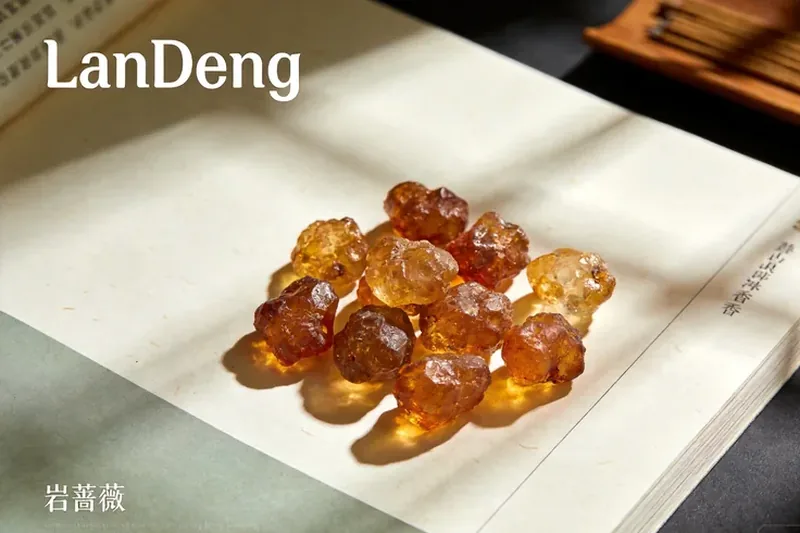
Direct answer: Labdanum (岩蔷薇, yánqiángwēi, “rock rose”) is the resinous exudate of Cistus ladanifer, the gum rockrose, a shrub of the rockrose family (Cistaceae) native to the western Mediterranean. It is a deep, balsamic, leathery, amber-like resin used in modern perfumery as a base and fixative. It is a modern crossover material, not part of the classical Chinese incense canon.
Key facts
| Chinese | 岩蔷薇 (yánqiángwēi) — “rock rose”; the resin is also called 劳丹脂 / 赖百当 |
| Botanical source | Cistus ladanifer (family Cistaceae) — the resinous exudate |
| What it is | A plant resin, from a Mediterranean shrub |
| Aroma | Resinous, balsamic, leathery, amber |
| Traditional role | Modern perfumery base and fixative (not classical Chinese) |
Aroma profile
Direct answer: Labdanum is deep and resinous, with a balsamic sweetness over a leathery, smoky, amber-like base — sometimes described as the “ambergris of the plant world” for its animalic warmth. It is a base note and fixative: it anchors a blend from below, adding richness and tenacity, and is a cornerstone of amber and chypre accords in Western perfumery.
Labdanum is deep and resinous, with a balsamic sweetness over a leathery, smoky, amber-like base — sometimes described as the “ambergris of the plant world” for its animalic warmth. It is a base note and fixative: it anchors a blend from below, adding richness and tenacity. In modern Western perfumery it is a cornerstone of amber and chypre accords — a material whose job is to hold the composition together and give it depth, rather than to lead with a bright top.
Botanical identity
Direct answer: Cistus ladanifer is an evergreen shrub of the rockrose family (Cistaceae), native to the western Mediterranean — chiefly the Iberian Peninsula and North Africa. The family Cistaceae is unrelated to the rose family (Rosaceae); the name “rock rose” describes its habitat and rose-like flowers, not a botanical relation. The resin is gathered from the leaves and twigs.
Cistus ladanifer is an evergreen shrub of the rockrose family (Cistaceae), native to the western Mediterranean — chiefly the Iberian Peninsula and North Africa. It produces a sticky, aromatic resin (labdanum) on its leaves and twigs, traditionally gathered by combing the resin from the shrub or boiling the twigs. The family Cistaceae is unrelated to the rose family (Rosaceae); the name “rock rose” describes its habitat and rose-like flowers, not a botanical relation. See Cistus ladanifer on GBIF.
Chinese name and terminology
Direct answer: The Chinese name 岩蔷薇 (yánqiángwēi) means “rock rose” — a descriptive name that points to habitat and appearance, not to any classical Chinese incense use. The resin also carries the transliterated names 劳丹脂 (láodānzhī) and 赖百当 (làibǎidāng), which are loanwords rather than classical terms, marking the material as a modern, translated import.
The terminology is revealing:
- 岩蔷薇 (yánqiángwēi) — “rock rose,” a descriptive modern name for the shrub.
- 劳丹脂 (láodānzhī) / 赖百当 (làibǎidāng) — transliterations of “labdanum,” loanwords that mark the resin as a modern, translated import rather than a classical Chinese term.
None of these is a classical 香谱 (Xiang Pu) or 香乘 (Xiang Cheng) term. The names are modern and translated, which is consistent with the material’s status: a Western resin that arrived in the Chinese market through the global fragrance trade, not through the historical incense canon.
The modern-crossover point (read this)
Direct answer: 岩蔷薇 (labdanum) is not a classical Chinese incense material. It comes from a Mediterranean shrub, and its documented use is in modern Western perfumery, not in the historical 香谱 or 香乘 tradition. This encyclopedia includes it for completeness and comparison — as a modern resin that Chinese-market buyers may encounter through the global fragrance trade — not as a claim of classical Chinese origin.
岩蔷薇 (labdanum) is not a classical Chinese incense material. It comes from a Mediterranean shrub, and its documented use is in modern Western perfumery, not in the historical 香谱 (Xiang Pu) or 香乘 (Xiang Cheng) tradition of Chinese incense. This encyclopedia includes it for completeness and comparison — as a modern resin that Chinese-market buyers may encounter through the global fragrance trade — not as a claim of classical Chinese origin. This is a sourcing and category honesty note, and it matters because a buyer looking for an “authentic Chinese” incense material should not be sold labdanum on that basis.
The amber-accord function (read this)
Direct answer: Labdanum is a key natural source of the “amber” note in perfumery, and it is the backbone of the classic amber accord — typically built from labdanum, vanilla, and benzoin. Its leathery, smoky sweetness is what gives an amber base its warmth and tenacity, so labdanum is specified for function (a base and fixative), not for a floral or resin “top” character.
Labdanum’s defining function in perfumery is as the natural backbone of the amber note. The classic amber accord — the sweet, warm, resinous base that underlies countless fragrances — is typically built from three materials: labdanum, vanilla, and benzoin. Labdanum supplies the leathery, smoky, animalic warmth; vanilla the sweetness; benzoin the balsamic roundness. Together they produce the “amber” character that is not amber the fossil but a constructed accord, and labdanum is the part that gives it depth and tenacity.
This is the useful distinction for a buyer or formulator: labdanum is specified for function — a base and fixative that anchors and holds a composition — not for a bright top or a standalone character. It is an infrastructure material in perfumery, and its value is in what it does to the whole blend, not in how it smells alone.
Where does labdanum come from?
Direct answer: Labdanum comes from Cistus ladanifer, the gum rockrose of the western Mediterranean — chiefly Spain, Portugal, and North Africa. The resin is gathered from the shrub’s leaves and twigs, traditionally by combing the sticky resin or boiling the twigs, and is then refined into a concrete or absolute.
Cistus ladanifer is native to the western Mediterranean — chiefly the Iberian Peninsula (Spain and Portugal) and North Africa — where it grows on dry, sunny, often rocky slopes. The resin (labdanum) is produced on the leaves and twigs and traditionally gathered either by combing the sticky resin from the shrub (a method with a long history) or by boiling the twigs to release it. The raw resin is then refined into a concrete or an absolute for perfumery. The material is therefore a Mediterranean product at every stage, with no classical Chinese counterpart.
Why is it used (in modern perfumery and incense)?
Direct answer: Labdanum is used as a base and fixative — it anchors a fragrance from below, adds richness and tenacity, and supplies the leathery warmth of the amber accord. It also appears in some modern incense and resin blends through the global fragrance trade, though it is not a classical Chinese incense material.
Labdanum’s role is as a base and fixative. It anchors a fragrance from below, adding richness and tenacity, and is central to amber and chypre accords. It also appears in some modern incense and resin blends through the global fragrance trade — but this is a modern crossover use, not a classical Chinese one. The key framing for this encyclopedia: labdanum is a modern Western material that a Chinese-market buyer might meet through global perfumery and modern incense, and it should be understood and bought on those terms, not as a traditional Chinese incense ingredient.
How is it processed?
Direct answer: Labdanum is gathered from the resinous leaves and twigs of the rockrose, either by combing the sticky resin or by boiling the twigs, and then refined into a concrete (a solvent extract) or an absolute (an alcohol-washed, more refined extract). The refined forms, not the raw shrub, are the commercial materials.
Processing runs from the shrub to a refined extract:
- Gathering — the sticky resin is combed from the leaves and twigs, or the twigs are boiled to release it.
- Concrete — the raw resin is solvent-extracted into a dark, semi-solid concrete.
- Absolute — the concrete is washed with alcohol to yield the absolute, a more refined form.
The commercial materials are the concrete and absolute, not the raw shrub; a buyer specifying labdanum is normally specifying one of these refined forms, and the quality marker is a deep, leathery, balsamic richness without harsh solvent notes.
What determines labdanum quality?
Direct answer: Quality turns on richness and cleanliness: a deep, leathery, balsamic character without harsh or solvent off-notes. The material is bought as a refined concrete or absolute, so the refining quality — and the absence of solvent residue — is the practical check, more than the raw shrub itself.
The quality factors, in rough order:
- Richness — a deep, leathery, balsamic, amber-like character; a rich base beats a thin or flat one.
- Cleanliness — freedom from harsh solvent or off-notes; this reflects the quality of extraction.
- Form — concrete vs absolute, matched to the application.
- Identity — labdanum (Cistus ladanifer), not a fossil amber or a synthetic “amber” accord.
There is no single standardized ladder, but “deep, clean, and correctly identified” is the durable signal.
Common forms
Direct answer: Labdanum is sold as a concrete (a solvent extract) and an absolute (a more refined alcohol-washed extract), with the absolute the more refined and costly form. The raw resin is gathered from the shrub, but the refined extracts are the commercial materials.
| Form | Typical use |
|---|---|
| Concrete | Perfumery base; amber and chypre accords |
| Absolute | Refined perfumery use |
In modern practice
- Perfumery (Modern Industry Practice): labdanum is a staple base and fixative of modern Western perfumery, central to amber and chypre accords and valued for its tenacity.
- Amber accords (Modern Industry Practice): labdanum is a key natural source of the “amber” note in perfumery, the backbone of the classic labdanum–vanilla–benzoin accord.
- Incense (Modern Industry Practice): labdanum appears in some modern incense and resin blends through the global fragrance trade, though it is not a classical Chinese incense material.
Traditional use vs modern evidence
Direct answer: Labdanum’s documented use is in modern perfumery, not in classical Chinese medicine or incense. This page makes no medical claims and does not fabricate a classical Chinese pedigree. The documented facts are botanical identity, the Mediterranean origin, and the modern perfumery role.
- Traditional Use — labdanum has a long history in Mediterranean perfumery, but no classical Chinese incense or materia-medica role is claimed.
- Historical Record — the material’s use in Western perfumery and its gathering from Cistus ladanifer are documented; no 香谱/香乘 entry exists.
- Scientific Evidence — the botanical identity of Cistus ladanifer and the resin’s chemistry are documented; we present no clinical or medical efficacy claims.
Labdanum’s documented use is in modern perfumery, not in classical Chinese medicine or incense. We make no medical claims and do not fabricate a classical Chinese pedigree.
What buyers should look for
Direct answer: Buyers should recognize 岩蔷薇 as a modern Western material, not a classical Chinese incense ingredient — buy it for modern amber or resin accords, not as an “authentic Chinese” material. Then judge the extract form and quality: a deep, leathery, balsamic richness without harsh solvent notes. And note that “rock rose” is not a true rose.
For a buyer:
- Category honesty — 岩蔷薇 is a modern Western material; buy it for modern amber or resin accords, not as a classical Chinese incense ingredient.
- Form — concrete vs absolute, matched to the application.
- Quality — a deep, leathery, balsamic richness without harsh solvent or off-notes.
- Naming — “rock rose” is not a true rose (Rosa); Cistaceae is unrelated to Rosaceae.
Our Industry View
Direct answer: Labdanum’s commercial lesson is category honesty. It is a base-and-fixative material whose value is functional — it holds a blend together and supplies amber warmth — and whose provenance is modern Western perfumery, not classical Chinese incense. A buyer should specify it by function and form, and never accept it dressed up as a “classical Chinese” material.
From a manufacturing perspective, labdanum teaches a discipline this encyclopedia values: category honesty. Three points follow:
- It is an infrastructure material. Labdanum’s value is functional — a base and fixative that anchors a composition and supplies amber warmth — not a character to lead with. A buyer or formulator should specify it by function (base, fixative) and form (concrete, absolute), not by a “top note” description it does not deliver.
- Provenance is honest. The material is a modern Western perfumery resin. In a Chinese-market context, the honest framing is “a modern crossover resin from the global fragrance trade,” not “a classical Chinese incense material.” Dressing it up as the latter would be a category error — and a buyer should reject that framing if it is offered.
- The amber note is constructed, not extracted. The “amber” character labdanum helps build is an accord (labdanum–vanilla–benzoin), not amber the fossil. Keeping that distinction straight prevents confusion between a natural resin, a constructed accord, and a fossilized resin.
In our view, labdanum is a fine base-and-fixative resin for modern amber and chypre work — buy it by form and function, prefer a clean, rich extract, and keep its modern-Western provenance clearly labeled.
Summary
Labdanum (岩蔷薇, “rock rose”) is the resinous exudate of Cistus ladanifer, a Cistaceae shrub of the western Mediterranean, whose deep, leathery, amber-like character made it a cornerstone base and fixative of modern Western perfumery — the natural backbone of the labdanum–vanilla–benzoin amber accord. It is a modern crossover material with no classical Chinese incense pedigree, included here for completeness and comparison. It makes no medical claims, and “rock rose” is not a true rose.
FAQ
What is labdanum (岩蔷薇)? The resinous exudate of Cistus ladanifer, the gum rockrose, a shrub of the rockrose family (Cistaceae) native to the western Mediterranean. It is a deep, balsamic, leathery, amber-like resin used in modern perfumery as a base and fixative. The Chinese name 岩蔷薇 means “rock rose,” and the resin is also called 劳丹脂 or 赖百当.
Is labdanum a classical Chinese incense material? No. Labdanum comes from a Mediterranean shrub and its documented use is in modern Western perfumery, not in the historical 香谱 or 香乘 tradition of Chinese incense. This encyclopedia includes it for completeness and comparison — as a modern resin that Chinese-market buyers may meet through the global fragrance trade — not as a claim of classical Chinese origin.
What does labdanum smell like? Deep and resinous, with a balsamic sweetness over a leathery, smoky, amber-like base — sometimes called the “ambergris of the plant world” for its animalic warmth. It is a base note and fixative that anchors a blend from below, adding richness and tenacity, and is a cornerstone of amber and chypre accords in Western perfumery.
Is “rock rose” a rose? No. The rockrose family (Cistaceae) is unrelated to the rose family (Rosaceae). The name “rock rose” describes the shrub’s rocky habitat and rose-like flowers, not a botanical relation to true roses (Rosa). The useful part is the sticky, aromatic resin the shrub produces on its leaves and twigs, not a flower.
What is labdanum used for? Primarily as a base and fixative in modern Western perfumery, where it is central to amber and chypre accords and is a key natural source of the “amber” note — the backbone of the classic labdanum–vanilla–benzoin accord. It also appears in some modern incense and resin blends through the global fragrance trade. It is not a classical Chinese incense material.
What is the difference between labdanum and amber? Labdanum is a natural resin from Cistus ladanifer, while the “amber” note in perfumery is a constructed accord typically built from labdanum, vanilla, and benzoin — and fossil amber (琥珀) is yet another, unrelated material. So labdanum contributes to the amber note; it is not itself amber, and neither is the amber accord a fossil resin. The three are often conflated and worth keeping straight.
How is labdanum processed? The sticky resin is gathered from the rockrose’s leaves and twigs — by combing it off or by boiling the twigs — and then refined into a concrete (solvent extract) and, further, an absolute (alcohol-washed, more refined). The concrete and absolute are the commercial materials, and the quality marker is a deep, leathery richness without harsh solvent notes.
See also: frankincense, myrrh, benzoin, amber, and the full scent guide.
Evidence & Sources
Botanical identity
Source: Cistus ladanifer on GBIF. Evidence type: Established.
Modern perfumery use
Source: labdanum as a base/fixative and amber-accord source in modern Western perfumery; the resin is gathered from Cistus ladanifer twigs. Evidence type: Industry practice.
Sourcing / provenance
Source: 岩蔷薇 is a modern Western material, not part of the classical Chinese 香谱/香乘 tradition. Evidence type: Transparency note — no classical Chinese origin claimed.
Safety
Source: incense combustion produces smoke and particulate matter; burn in a well-ventilated space. Evidence type: Established.
Evidence status
| Layer | Status |
|---|---|
| Botanical identity | Established |
| Modern perfumery use | Industry practice |
| Classical Chinese origin | Not claimed (modern crossover) |
| Health claims | Not established |
Sources
Sources: botanical references on Cistus ladanifer and labdanum’s modern perfumery role. Labdanum is documented as a modern Western resin, not a classical Chinese incense material; no classical origin is claimed and no medical claims are made. This is editorial knowledge content, not medical advice.