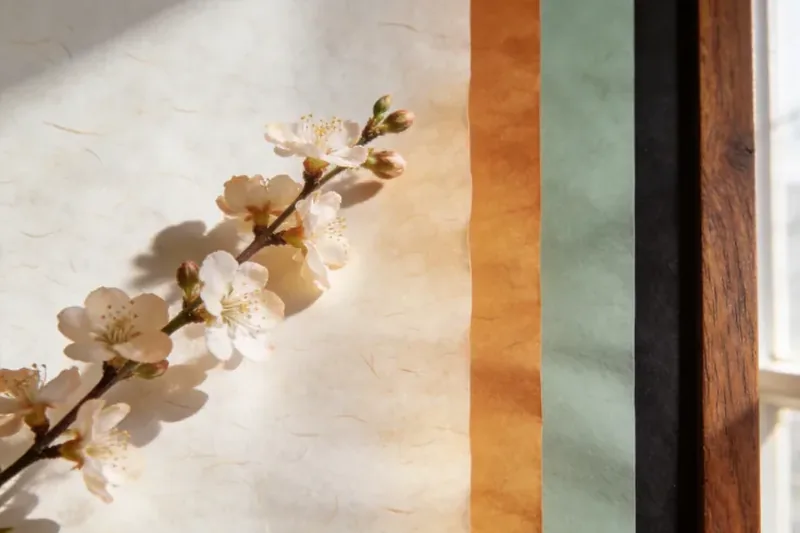
Direct answer: Silk tree flower (合欢花, héhuān huā) is the flower of Albizia julibrissin (合欢, “collective joy”), a legume tree (Fabaceae) native to Asia. Its pink, thread-like blossoms carry a delicate sweet scent, and the tree is a famous cultural plant: the Bencao Gangmu records 合欢, quoting the saying that it dispels anger and calms the heart — a cultural association rather than a documented incense use.
Key facts
| Chinese | 合欢花 (héhuān huā); the tree 合欢, also 合昏, 夜合 |
| Botanical source | Albizia julibrissin (family Fabaceae) — the flower |
| What it is | A delicate pink flower of a culturally famous tree |
| Aroma | Sweet, floral, delicate, slightly powdery |
| Traditional role | Cultural symbol; 合欢 in materia medica |
Aroma profile
Direct answer: Silk tree flower has a delicate, sweet, slightly powdery floral scent — a soft, light perfume that suits its airy, pink, thread-like blossoms. It is gentler and more diffuse than the richer white florals like jasmine or osmanthus, reading as a quiet garden note. Its aromatic value is modest; the tree’s fame rests on cultural meaning, not fragrance strength.
Silk tree flower has a delicate, sweet, slightly powdery floral scent — a soft, light perfume that suits its airy, pink, thread-like blossoms. It is gentler and more diffuse than the richer white florals like jasmine or osmanthus, reading as a quiet garden note. Its aromatic value is modest; the tree’s fame rests more on its cultural meaning and its place in materia medica than on any strong fragrance — a point this page records honestly rather than inflating.
Botanical identity
Direct answer: Albizia julibrissin is a deciduous legume tree (Fabaceae). Flora of China describes a tree to 16 m tall with an open crown, feathery bipinnate leaves whose leaflets fold at night, and pink flowers with thread-like pink stamens about 2.5 cm long, flowering May–July. Its leaves fold together at night, giving the classical names 合昏 and 夜合.
Flora of China describes Albizia julibrissin precisely: deciduous trees to 16 m tall, crown open; branchlets angular; leaves bipinnate with 4–12 pairs of pinnae and 10–30 pairs of small, obliquely linear leaflets 6–12 × 1–4 mm; flowers pink, the filaments pink and about 2.5 cm long, in terminal panicles; legume strap-shaped, flat, 9–15 × 1.5–2.5 cm; flowering May–July, fruiting August–October. Its leaves fold together at night — the “sleep movement” that gives the classical names 合昏 and 夜合 (“night-closing”). It is widely cultivated across China and in central, eastern, and southwestern Asia. See Albizia julibrissin in Flora of China and Albizia julibrissin on GBIF.
Chinese name and terminology
Direct answer: The name 合欢 means “collective joy” (also “conjoining joy”), naming the tree as a symbol of harmony and reunion. The classical names 合昏 and 夜合 (“night-closing”) record a botanical behavior — the leaves fold at night — not a fragrance. The flower (合欢花) is a part of the tree 合欢, recorded in the Bencao Gangmu for its cultural and materia-medica associations.
The name 合欢 means “collective joy” (also “conjoining joy”), naming the tree as a symbol of harmony and reunion — a meaning, not a scent. The classical alternates are botanical:
- 合欢 (héhuān) — “collective joy,” the tree.
- 合昏 (héhūn) / 夜合 (yèhé) — “night-closing,” recording the leaves folding at night.
The flower (合欢花) is one part of the tree 合欢, and the tree is recorded in the Bencao Gangmu (本草纲目), tree section (木之二), for its cultural and materia-medica associations — not for a strong fragrance.
A cultural note (read this)
Direct answer: 合欢 is famous in Chinese culture for its meaning, not its incense role. The Bencao Gangmu records 合欢 with the names 合昏 and 夜合, and quotes the classical line “合欢蠲忿,萱草忘忧” — 合欢 dispels anger, the daylily forgets sorrow. This is a cultural and materia-medica association, not a documented burned-incense use.
合欢 is famous in Chinese culture for its meaning, not its incense role:
- The name 合欢 means “collective joy” (also “conjoining joy”), and the tree is a symbol of harmony and reunion.
- The Bencao Gangmu (本草纲目), tree section (木之二), records 合欢 with the alternative names 合昏 and 夜合 (its leaves close at night), and quotes the classical line “合欢蠲忿,萱草忘忧” — 合欢 dispels anger, the daylily forgets sorrow.
- This is a cultural and materia-medica association, not a documented burned-incense use; the flower is not a staple of the 香乘 (Xiang Cheng) canon.
This page records 合欢花 honestly as a cultural and materia-medica flower, without inventing a classical incense role.
Where does silk tree come from?
Direct answer: Albizia julibrissin is native to a broad swath of Asia and widely planted for its feathery foliage and pink summer blossoms, from China through central, eastern, and southwestern Asia. Flora of China records it as widely cultivated across many Chinese provinces.
Albizia julibrissin is native to a broad swath of Asia and widely planted for its feathery foliage and its pink, thread-like summer blossoms, from China through central, eastern, and southwestern Asia. Flora of China records it as widely cultivated across many Chinese provinces — Anhui, Fujian, Gansu, Guizhou, Henan, Hubei, Hunan, Jiangsu, Jiangxi, Shandong, Shanxi, Taiwan, Yunnan, and Zhejiang, among others. Its status is ornamental and cultural as much as botanical: it is planted for its appearance and meaning, and its fame travels with the tree rather than with the flower as a distinct commodity.
Why is it (and isn’t it) used in incense?
Direct answer: 合欢花’s classical fame is cultural and materia-medica, not incense — it is not a staple of the 香乘 canon. Its delicate, sweet, powdery floral can lend a quiet garden note, but it is not a lead 香材, and this page records that honestly rather than assigning it an incense role it does not documentedly hold.
合欢花’s position is subtle and worth stating precisely. The tree is famous — but for meaning, not fragrance. The flower is not a staple of the 香乘 (Xiang Cheng) canon, and its documented classical role is cultural (the “collective joy” symbol, the “合欢蠲忿” line) and materia-medica, not burned incense. Its delicate, sweet, slightly powdery floral can lend a quiet garden note in a blend, but it is not a lead 香材, and this page records that honestly. A buyer should position it as a gentle floral and a cultural plant, not as a canonical incense ingredient.
How is it processed?
Direct answer: 合欢花 is a flower, handled by gentle drying to preserve its delicate, sweet, powdery note. The flower is light and the scent diffuse, so drying is about preservation rather than concentration; there is no classical tapping, grinding, or distillation tradition for it as an incense material.
As a delicate flower, 合欢花 is handled by gentle drying to preserve its sweet, powdery note. The flower is light and its scent diffuse, so processing is a preservation question rather than a concentration one — and because the flower is not a canonical incense material, there is no classical tapping, grinding, or distillation tradition attached to it. The dried flower, whole or lightly broken, is the form encountered; its value is quiet and modest rather than intense.
What determines silk tree flower quality?
Direct answer: Quality turns on freshness and gentleness of drying — a clean, well-dried flower that retains its delicate, sweet, powdery note. Because the scent is diffuse to begin with, a faded or musty batch has little aromatic value, and the material should be positioned as a gentle floral, not judged as a strong 香材.
The quality factors, in rough order:
- Aroma — delicate, sweet, slightly powdery; a clean, gentle note beats a faded or musty one.
- Condition — clean, well-dried flower, free of mold and damage.
- Freshness — the diffuse note fades with age.
- Positioning honesty — a gentle floral and cultural plant, not a lead incense material.
There is no standardized commercial grading ladder for 合欢花; aroma and condition are the practical signals, with the caveat that the scent is modest by design.
Common forms
Direct answer: 合欢花 is sold as the dried flower, whole or lightly broken. There is no meaningful wood, resin, or distilled-oil form in classical practice, consistent with its status as a gentle floral rather than a canonical incense material.
| Form | Typical use |
|---|---|
| Dried flower | Gentle floral note; cultural/scenting use |
| Crushed flower | Blended incense (supporting) |
In Chinese tradition
- Cultural symbol (Historical Record): 合欢 is a symbol of harmony and joyful reunion; its name means “collective joy.”
- The classical line (Historical Record): the Bencao Gangmu (本草纲目) quotes “合欢蠲忿,萱草忘忧” — a cultural statement about calming the heart, not a fragrance claim.
- Materia medica (Traditional Use): 合欢 appears in traditional Chinese medicine. This is traditional materia-medica language, not modern clinical evidence.
Traditional use vs modern evidence
Direct answer: The cultural symbolism is well documented; the materia-medica record is traditional, not established clinical fact, and this page makes no medical claims. The documented facts are botanical identity, the Fabaceae placement, the cultural record, and the honest absence of a 香乘 incense role.
- Traditional Use — 合欢 as a cultural symbol and a materia-medica item.
- Historical Record — the Bencao Gangmu (本草纲目), 木之二, records 合欢 with the names 合昏 and 夜合 and quotes “合欢蠲忿,萱草忘忧.”
- Scientific Evidence — the botanical identity of Albizia julibrissin (Fabaceae) and its chemistry are documented; we present no clinical or medical efficacy claims.
The cultural symbolism is well documented; the materia-medica record is traditional, not established clinical fact, and we make no medical claims.
What buyers should look for
Direct answer: Buyers should expect a delicate, sweet, slightly powdery floral from a clean, well-dried flower, and position it as a gentle floral and cultural plant, not a lead 香材. Its classical fame is cultural and materia-medica, not incense — it is not a staple of the 香乘 canon — so it should not be bought as a strong or canonical incense ingredient.
For an incense maker or sourcing buyer:
- Expectation — a delicate, sweet, slightly powdery floral; not a strong or deep note.
- Condition — clean, well-dried flower.
- Positioning — a gentle floral and cultural plant, not a lead 香材 or a 香乘 staple.
Our Industry View
Direct answer: 合欢花’s commercial lesson is honesty about what a plant is famous for. The silk tree is celebrated for meaning — “collective joy,” “dispels anger” — not for fragrance, and its flower is not a 香乘 incense material. A buyer should value it for its quiet floral and its cultural story, not market it as a strong 香材 it is not.
From a manufacturing perspective, 合欢花 teaches a discipline this encyclopedia values: don’t inflate a plant’s fame into an incense claim. Two points follow:
- Cultural fame is not fragrance strength. The silk tree is one of the most meaning-laden plants in the classical record — “collective joy,” “合欢蠲忿” — but that meaning is cultural and materia-medica, not aromatic. Its flower’s scent is delicate and diffuse. A buyer who reads the tree’s fame as a promise of a strong incense note is reading the wrong signal; the material is a quiet floral, and it should be bought and sold as that.
- Honest positioning protects the catalog. This encyclopedia’s value is that it does not assign incense roles to plants that do not documentedly hold them. 合欢花 is a gentle floral and a cultural plant, not a 香乘 staple; recording that plainly is what keeps the entity map trustworthy, and it is the same honesty that lets the genuinely canonical materials stand out.
In our view, 合欢花 is a delicate, culturally resonant floral — buy it for its quiet sweet-powdery note and its story, judge it by freshness, and do not position it as a lead incense material.
Summary
合欢花 (héhuān huā) is the delicate pink flower of the silk tree, Albizia julibrissin (Fabaceae), a tree whose name “collective joy” and whose “合欢蠲忿,萱草忘忧” line make it a famous cultural symbol rather than a fragrance. Its sweet, powdery floral is gentle and diffuse, and it is not a staple of the 香乘 canon — this page records it honestly as a cultural and materia-medica flower without inventing an incense role. Its medicinal uses are traditional language, not clinical evidence.
FAQ
What is 合欢花 (silk tree flower)? The flower of the silk tree, Albizia julibrissin (合欢), a legume tree (Fabaceae) native to Asia. Its pink, thread-like blossoms carry a delicate sweet scent, and the tree is famous in Chinese culture for its meaning — the name 合欢 means “collective joy.” Flora of China describes a deciduous tree to 16 m tall whose pink flowers bloom May–July.
Why is it called 合欢 (collective joy)? The name 合欢 means “collective joy” (also “conjoining joy”), and the tree is a symbol of harmony and reunion. The Bencao Gangmu (本草纲目) also records the names 合昏 and 夜合, because the leaves fold together at night. The classical line “合欢蠲忿,萱草忘忧” (合欢 dispels anger, the daylily forgets sorrow) reflects its cultural association with calming the heart.
What does 合欢花 smell like? Delicate, sweet, and slightly powdery — a soft, light floral perfume suited to its airy, pink, thread-like blossoms. It is gentler and more diffuse than richer white florals like jasmine or osmanthus, reading as a quiet garden note rather than a strong fragrance.
Is silk tree flower a classical incense ingredient? Not as a staple. 合欢’s classical fame is cultural and materia-medica, not a burned-incense role, and it is not a lead material of the 香乘 (Xiang Cheng) canon. This page records it as a cultural and materia-medica flower without inventing an incense role.
Does 合欢 appear in the Bencao Gangmu? Yes. The Bencao Gangmu (本草纲目), tree section (木之二), records 合欢 with the names 合昏 and 夜合 and quotes the classical line “合欢蠲忿,萱草忘忧.” The record is cultural and materia-medica, and medicinal uses are traditional, not established clinical fact.
What part of the plant is used? The flower — the pink, thread-like blossom of Albizia julibrissin — is the part used for its delicate scent. The tree itself is the cultural and materia-medica subject, and its leaves fold at night (the source of the names 合昏 and 夜合). The flower is a gentle floral, not a strong incense material.
See also: honeysuckle, osmanthus, lotus flower, and the full scent guide.
Evidence & Sources
Botanical identity
Source: Albizia julibrissin in Flora of China · Albizia julibrissin on GBIF. Evidence type: Established.
Traditional Chinese use
Source: the Bencao Gangmu (本草纲目), 木之二, records 合欢 with the names 合昏 and 夜合 and quotes “合欢蠲忿,萱草忘忧”. Evidence type: Historically documented — cultural and materia-medica; medicinal uses are traditional, not modern clinical evidence.
Authenticity / disambiguation
Source: 合欢花 (Albizia julibrissin, silk tree) — a cultural and materia-medica flower, not a 香乘 staple. Evidence type: Practical screening.
Safety
Source: incense combustion produces smoke and particulate matter; burn in a well-ventilated space. Evidence type: Established.
Evidence status
| Layer | Status |
|---|---|
| Botanical identity | Established |
| Traditional use | Historically documented (cultural, materia medica) |
| Authenticity test | Practical screening |
| Health claims | Not established |
Sources
Sources: botanical references on Albizia julibrissin and the Bencao Gangmu (本草纲目) 木之二 record of 合欢. 合欢花 is documented as a cultural and materia-medica flower; medicinal uses are treated as traditional, not established clinical fact. This is editorial knowledge content, not medical advice.