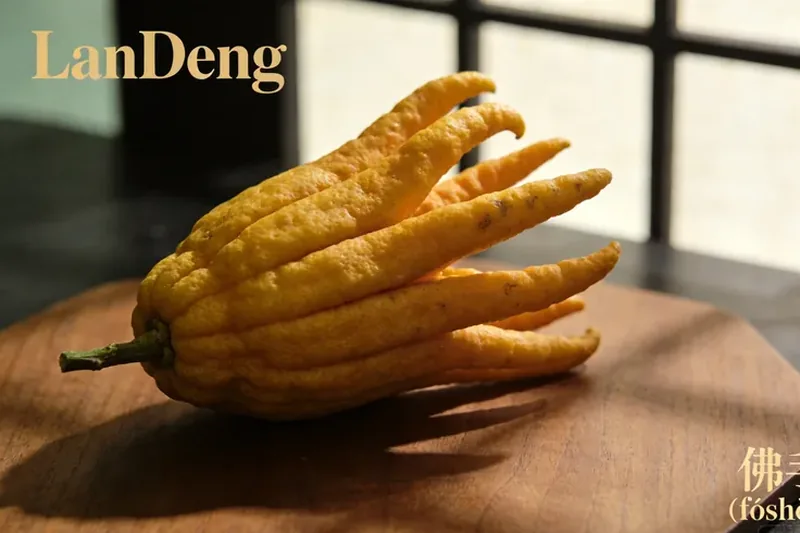
Direct answer: Finger citron (佛手, fóshǒu) is the Buddha’s hand, Citrus medica var. sarcodactylis, a fingered variety of the citron in the rue family (Rutaceae). It is prized for its intensely fragrant, thick rind and is used as a 清供 (scholar’s-table offering) fragrance fruit, scenting a room by its presence rather than being burned as incense. It is a variety of, and distinct from, the plain citron (香橼).
Key facts
| Chinese | 佛手 (fóshǒu) — “Buddha’s hand”; also 佛手柑 |
| Botanical source | Citrus medica var. sarcodactylis (family Rutaceae) — the fruit |
| What it is | A fragrant citrus fruit, not a wood or resin |
| Aroma | Citrus, floral, sweet, bright |
| Traditional role | 清供 offering fruit; room fragrance |
Aroma profile
佛手 is citrus and floral at once, with a bright, sweet, lemony-floral rind scent that is more perfumed and less tart than an orange or pomelo. The fragrance comes from the thick rind and its oil, not the juice — the finger citron has almost no pulp. In a room it reads as a clear, elegant citrus-floral, and its scent is experienced by proximity and evaporation rather than by burning.
The 佛手 / 香橼 relationship (read this)
佛手 and 香橼 are not two unrelated fruits — 佛手 is a variety of the citron:
- 香橼 (citron) — Citrus medica, the parent species, a fragrant, thick-rinded citrus. Its own entry.
- 佛手 (finger citron) — Citrus medica var. sarcodactylis, a cultivar/variety whose fruit splits into finger-like segments. This entry.
Both are grown for fragrant rind rather than juice, and both are used as 清供 and room-fragrance fruits. This page describes 佛手 = the fingered citron. When a source means the plain fruit, it is describing 香橼.
Botanical source and origin
Citrus medica var. sarcodactylis is a variety of the citron (Citrus medica), itself one of the oldest cultivated citrus, native to the foothills of the Himalaya and long grown across China. In the finger citron the fruit’s carpels fail to fuse, so the rind develops into separate finger-like segments. Flora of China treats the fingered form within Citrus medica (recording sarcodactylis), and GBIF lists the variety name as a synonym of Citrus medica.
In Chinese tradition
- 清供 (scholar’s-table offering): 佛手 is a classic 清供 fruit, displayed for its fragrance and its auspicious “hand of Buddha” form, especially around the New Year.
- Room fragrance: the fruit scents a room by evaporation from its oil-rich rind — a fragrance of presence, not of combustion.
- Not a 香乘 incense ingredient: 佛手 does not appear in the classical incense compendium 香乘; its role is as a displayed fragrance fruit, not a burned incense material.
Traditional use vs modern evidence
The 清供 and room-fragrance use is well documented. We make no medical claims. The documented, non-medical facts are botanical identity, the Rutaceae placement and citron relationship, and the fragrant offering-fruit use.
Quality and sourcing notes
Practical points for buyers:
- 佛手 is the finger citron (Citrus medica var. sarcodactylis); expect a sweet, floral, lemony rind scent from the thick, oil-rich skin, not the juice (there is almost none).
- It is a fragrance fruit for display and room scent, not a burned incense material, and is not a 香乘 ingredient.
- Distinguish it from the plain 香橼 (Citrus medica) — same species, different fruit form.
Safety
Incense combustion produces smoke and particulate matter. Burn in a well-ventilated space, avoid inhaling concentrated smoke, and keep away from children and pets. This is editorial knowledge content, not medical advice.
FAQ
What is 佛手 (finger citron)? The finger citron or Buddha’s hand, Citrus medica var. sarcodactylis, a fingered variety of the citron in the rue family (Rutaceae). Its fruit splits into finger-like segments with an intensely fragrant, thick, oil-rich rind and almost no pulp. It is used in Chinese culture as a 清供 offering and room-fragrance fruit.
Is 佛手 the same as 香橼 (citron)? They are the same species in different forms. 香橼 is the plain citron (Citrus medica), and 佛手 is its fingered variety (Citrus medica var. sarcodactylis). Both are grown for fragrant rind rather than juice, and both are used as 清供 and room-fragrance fruits. Each has its own entry here.
What does finger citron smell like? Citrus and floral at once — a bright, sweet, lemony-floral rind scent that is more perfumed and less tart than an orange or pomelo. The fragrance comes from the thick rind and its oil, not the juice (the finger citron has almost no pulp), and it scents a room by evaporation rather than by burning.
How is 佛手 used in Chinese culture? As a 清供 (scholar’s-table offering) fruit, displayed for its fragrance and its auspicious “hand of Buddha” form, especially around the New Year. Its oil-rich rind scents a room by presence and evaporation. It is a fragrance fruit for display, not a burned incense material, and it does not appear in the classical incense compendium 香乘.
Is finger citron eaten? Mostly not for its fruit flesh — the finger citron has almost no pulp or juice. Its value is the fragrant, thick rind, which may be candied or used to perfume spaces, and the whole fruit is grown and displayed for scent and symbolism. This contrasts with ordinary eating citrus like orange or pomelo.
See also: citron, orange-peel, and the full scent guide.
Evidence & Sources
Botanical identity
Source: Citrus medica in Flora of China (records var. sarcodactylis) · Citrus medica on GBIF. Evidence type: Established.
Traditional Chinese use
Source: 佛手 as a 清供 offering and room-fragrance fruit; no entry in the classical compendium 香乘. Evidence type: Historically documented — cultural use.
Authenticity / disambiguation
Source: 佛手 (Citrus medica var. sarcodactylis) vs 香橼 (Citrus medica). Evidence type: Practical screening.
Safety
Source: incense combustion produces smoke and particulate matter; burn in a well-ventilated space. Evidence type: Established.
Evidence status
| Layer | Status |
|---|---|
| Botanical identity | Established |
| Traditional use | Historically documented (cultural) |
| Authenticity test | Practical screening |
| Health claims | Not established |
Sources
Sources: botanical references on Citrus medica (including var. sarcodactylis) and the finger-citron-vs-citron relationship. 佛手 is documented as a 清供 and room-fragrance fruit; no medical claims are made. This is editorial knowledge content, not medical advice.